A rift between the right-wing Italian government and Spain's leftist rulers continues to grow over immigration and border security. It has been days since Italy’s conservative government led by Prime Minister Giorgia Meloni enacted stricter border controls at air and seaports, for any non-EU citizen traveling from Spain. The two countries do not share a border.
Two days later, Spain’s left-wing government, led by Prime Minister Pedro Sánchez, enacted reciprocal measures on any non-EU citizens traveling from Italy. Even EU citizens need to show their ID to move on, causing travel delays during a month when most Europeans travel, including over two million between Italy and Spain. At issue is border security.
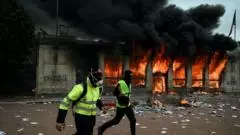
More specifically, the five-mile-long border between Morocco and the Spanish exclave of Ceuta. The reported that roughly 72,000 people reportedly attempted to illegally cross the border to Ceuta during the late July surge, before Spain and Morocco could reinforce the border to prevent what the EU calls "irregular migration." SPAIN STOCKS AFRICAN ENCLAVE CEUTA WITH BOOSTED SECURITY AS MOROCCO MONITORS CALLS FOR SECOND BORDER RUSH Emma Schubart of the Henry Jackson Society told Fox News Digital that Italy’s border checks and Spain’s reciprocal measures "highlight the Meloni–Sánchez divide: enforcement-first versus a regularization program that drew 1.2 million applications." On July 31, Meloni’s government, in what she called an "extraordinary measure," decided to "temporarily suspend the free movement regime (under the Schengen agreement) in maritime and air connections with Spain, reintroducing border controls," while also offering "to support every European initiative to assist Spanish institutions as needed to restore full control of the Union's external borders." The implementation involved random checks for non-EU travelers. Even some countries of Europe’s left are taking notice.
Meloni teamed up with Denmark’s left-leaning Prime Minister Mette Frederiksen to lead a group of 22 European Union leaders, including Hungary’s new Prime Minister Péter Magyar, in a letter calling for an "extraordinary" meeting of EU Interior Ministers to define a "coordinated European response." The letter placed blame on Spain, noting that "the recent ruling of the Spanish Supreme Court has been used to trigger this attack and abuse (of) our migration and asylum system." They added that the EU "cannot allow mass crossings, the instrumentalization of migration or other hybrid threats to create the perception that illegal entry into the European Union is possible." EU ADMITS IT ‘DIDN’T HAVE CONTROL’ ON MIGRATION AS BLOC RUSHES CRACKDOWN AHEAD OF NEW RULES Spain’s Supreme Court issued a July 8 ruling regarding the immediate return of migrants intercepted at sea while attempting to enter Ceuta or Melilla. Spain’s Sánchez called the letter "politically motivated," saying the situation in Ceuta was "under control" and that his government had acted in "full compliance with EU law." On his account, Sánchez posted "Solidarity and empathy are optional. Respect for European treaties and data is not… It is the time to continue building a strong and united EU," while noting EU Frontex data that there were 470,600 "irregular entries" via Italy since 2021, compared to Spain’s 234,760.
The Spanish Foreign Ministry said, "Entering Spain irregularly through Ceuta or Melilla does not grant the right to remain in the country, to travel to mainland Spain, or to move freely within Europe." Meloni responded on X that Ceuta "once again demonstrated how urgent it is for Europe to respond to illegal immigration. … Defending the external borders of the (European) Union is not the interest of a single Nation. It is a shared responsibility of Europe." As soon as the Italian border controls went into effect, Spain responded, with Sánchez's administration calling the controls "unjust" and "discriminatory towards the Spanish population." The Spanish warned of "proportionate measures" to defend their interests, reciprocating with their own border controls on Italian travel on August 8. The Palazzo Chigi, the office of the Italian prime minister, said, "Italy does not accept ultimatums or impositions from abroad regarding national security and border control.
Under no circumstances do we intend to review our decision… at least until 15 August… Another wave of migration is expected in Ceuta on that date, as the Spanish authorities themselves have announced." Morocco stepped in this past Saturday, August 15, ahead of that attempted rush on the border, with officials saying more than 111 were arrested attempting to reach Ceuta via mountain roads in an attempt to avoid check points. Morocco’s Le360 news agency said that the number was closer to 300. After the arrests, Italian foreign ministry officials told the AGI news agency they were "closely monitoring what is happening in Morocco and reaffirm the necessity of the measures adopted," with a spokesman telling ANSA, "The checks at the border with Spain remain necessary in light of the latest developments in Morocco." NATO ALLY POLAND WARNS RUSSIA, BELARUS PUSHING ILLEGAL MIGRANTS TOWARD ALLIANCE — AND THE US Lorenzo Vidino, director of the Program on Extremism at George Washington University, told Fox News Digital that this "Tit for tat" between the two countries could continue "for the foreseeable future." Vidino said EU immigration policies are "complicated" because "there is one policy, but enforcement is by the country," so politics plays a role.
Extract — continue reading at the source.