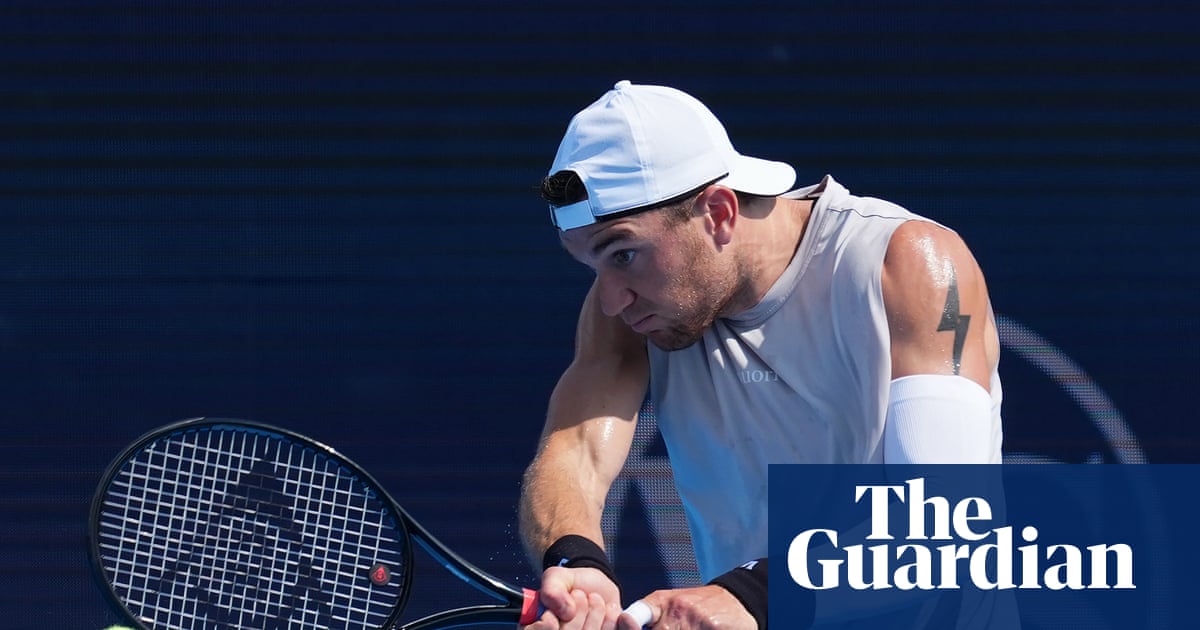
The minuscule amount of confidence and self-belief Jack Draper currently has to call upon in the most difficult period of his career was underscored in the first game of his opening match in Cincinnati. Draper began his service game by shanking a forehand into the back fence, which he followed up with two double faults. He immediately fell down a break and never recovered.
A few fleeting positive moments followed, but this miserable start set the tone for another excruciating day for the former world No 4 as he could not escape the mental fatigue borne out of battling serious injury for 15 months and counting. Draper fell 6-3, 7-5 to Martín Landaluce, the world No 64. Obviously, the conditions and all the things that I’m changing is very hard to manage, but I think from just an internal point of view, it’s a difficult place to be right now.” Draper spent the final stretch of his first-round loss at the Canadian Open last week in tears.
On Wednesday, as he tried to put on a brave face and remain positive, the 24-year-old described his emotions as a reaction to the mental toll of both his injury – bone bruising in his left arm – and the disruptive changes he has made in order to lessen the strain on it. There were no tears this time, but between a poor first set and the way he squandered six set points in set two after leading with a double break at 5-2, Draper was a shadow of himself. He said: “From the start of the match, you’re battling it a lot and you’re trying to keep going with it and moving forwards throughout the match and trying to … pump stuff up and give you energy, but it just suppresses you down.
It’s got to a point with me where it’s taken probably one of my biggest qualities, my fighting spirit.” Since Wimbledon, Draper has changed his strings, his racket and he continues to adjust to his service motion. These changes have all been made in service of reducing the strain on his arm and at the expense of optimising his performance. Although Draper said his injury did not directly contribute to the loss, the great uncertainty surrounding the condition of his arm remains the defining problem.
Unlike most injuries, this is not a case of resting for some time and coming back. You have to figure it out. A lot of it’s probably, I found out in the end, biomechanics and changing rackets.
It’s a tough injury because you have to start again with what you do. That starts to go away, but obviously the arm is linked to the elbow. It’s linked to bicep tendinitis, it’s linked to so many nerves around that area.
Extract — continue reading at the source.