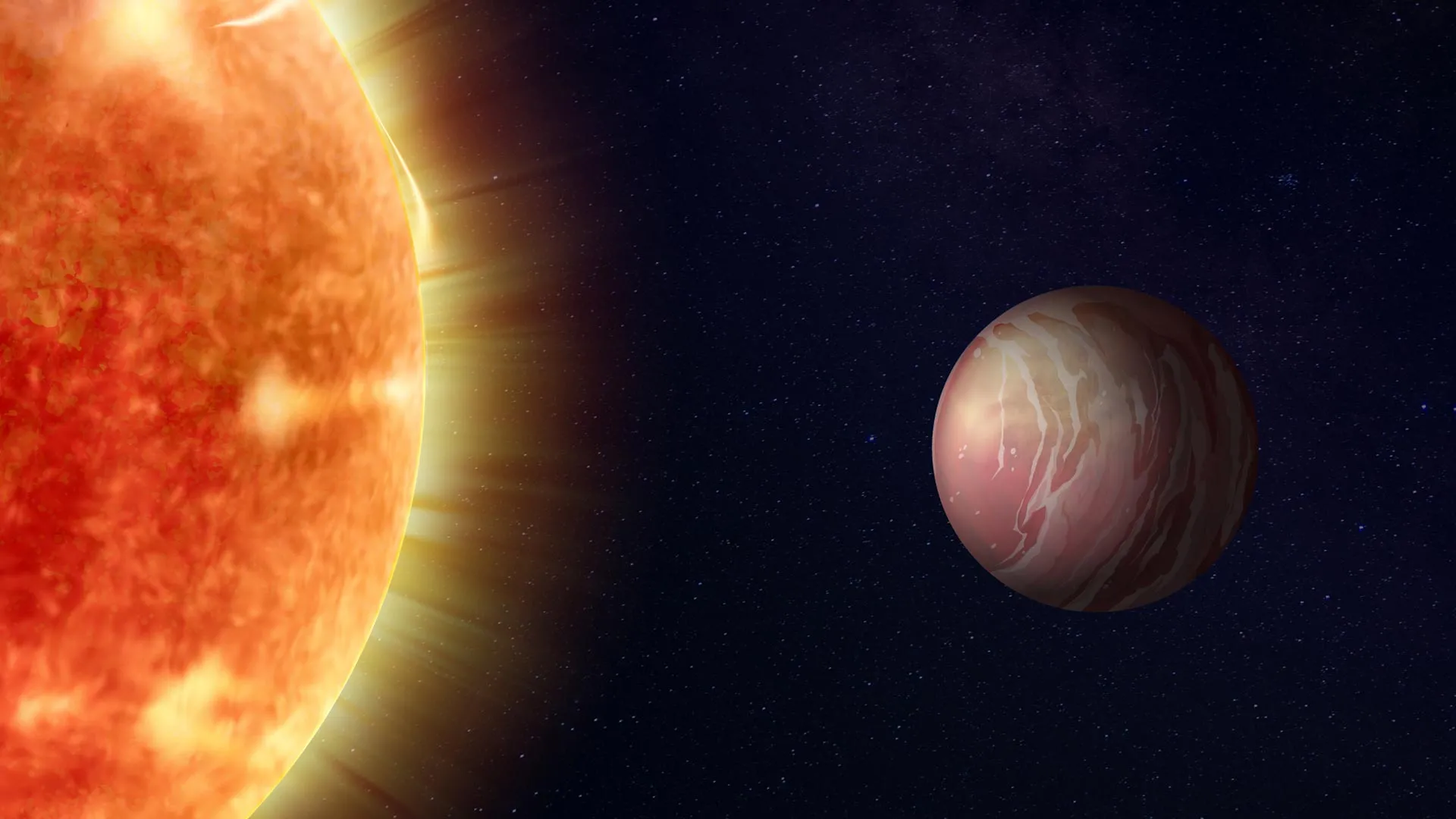
Astronomers have discovered surprising evidence that a scorching planet covered in molten rock may be protected by a reflective layer of clouds that acts like a giant sunscreen. Scientists previously believed that the planet's extreme conditions would make it nearly impossible for an atmosphere to survive, but new observations suggest otherwise. An international team of researchers, including Dr.
Anjali Piette, an astrophysicist at the University of Birmingham, reported the findings in The Astronomical Journal. Using the James Webb Space Telescope (JWST), the scientists monitored a rocky exoplanet called TOI-561 b, located approximately 280 light-years from Earth. Over 37 hours, they observed nearly four complete orbits around its host star.
The observations indicate that TOI-561 b may be surrounded by a substantial atmosphere, although its conditions would be far too hostile for life as we know it. This atmosphere appears to help the planet reflect much of the radiation coming from its star. One possible explanation is a layer of highly reflective silicate clouds that prevents the surface from reaching the extreme temperatures expected on an exposed rocky planet.
The atmosphere also appears to move heat from the permanently illuminated dayside toward the nightside, further reducing temperatures on the star-facing side. A Lava Planet With an Atmosphere That Should Have Disappeared Scientists still do not know exactly which gases make up the atmosphere of TOI-561 b. One possibility is a thick layer of carbon dioxide, resembling the atmosphere of Venus but under much hotter conditions.
Another is an atmosphere dominated by sulfur dioxide, a gas released by volcanic activity on Jupiter's moon Io. Anjali Piette, Assistant Professor in Astronomy at the University of Birmingham, said: "Our discovery challenges current theories. We would expect a heavily irradiated rocky planet like TOI-561 b to have lost its atmosphere billions of years ago.
"Instead, the evidence suggests it still has a significant atmosphere today. This raises major questions such as whether the planet started with an unusually large supply of gases or if the ocean of molten rock covering its surface, acts as a planet-wide volcano that is constantly feeding its atmosphere." James Webb Reveals Why the Planet Is So Reflective Earlier measurements revealed something puzzling about TOI-561 b. Its dayside was significantly cooler than researchers predicted for a dark, rocky planet orbiting so close to its star.
Extract — continue reading at the source.


