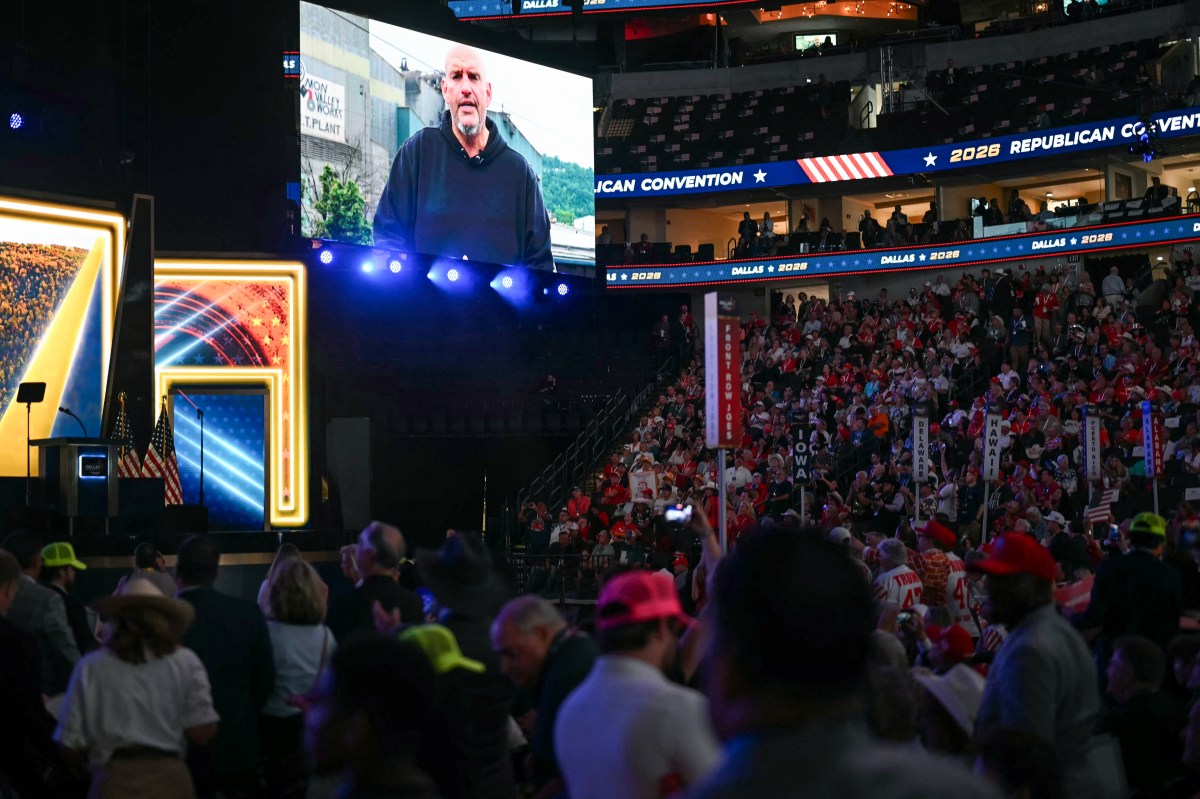
When Senator John Fetterman appeared by video at the GOP’s midterm convention in Dallas on Wednesday, a surprise virtual drop-in from the Democrat, he praised Republican Senator Dave McCormick as a friend and ally on Pennsylvania steel. Fetterman presented himself as a "common sense Democrat" willing to reject socialism and work with President Donald Trump and his Republicans. Naturally, Fetterman’s appearance among Republicans intensified speculation that he could eventually abandon the Democrats.
He later clarified that he was staying in his current party, though perhaps not all of his frustrated fellow Democrats took that as a positive. The Fetterman cameo at the GOP’s "Trumpalooza" reveals the reason why such a switch of parties could actually diminish the special political role he has built for himself on the Democratic side. Do you sense a contradiction?
Fetterman remains a Democratic senator, with the institutional significance that carries in a closely divided chamber, while an increasing share of his national political identity comes from disputes with Democrats. For Republicans, that can make his party label an asset rather than an obstacle. For Fetterman, it gives disagreements that might be ordinary inside the GOP considerably more attention and political meaning because of his Democratic colors.
Let’s call it the reverse-Manchin model. Joe Manchin spent most of his Senate career as a Democrat representing West Virginia, even as the state moved sharply toward Republicans. He formally became an independent in 2024 while continuing to caucus with Democrats before leaving the Senate in January 2025.
His leverage largely flowed from Democrats needing a senator capable of surviving in territory where the national party had become deeply unpopular. Fetterman’s position is different: he won Pennsylvania as a Democrat in 2022 and still occupies a Democratic seat, but some of his most visible moments now come when he departs from his party rather than when he advances its message. He has supported Israel more aggressively than many congressional Democrats, for example, and backed Trump during the Iran war.
He has also helped advance Trump’s nomination of Markwayne Mullin for homeland security secretary and repeatedly criticized the party’s left flank. At the same time, Fetterman insists that those differences do not make him a Republican. In July, he described himself as potentially the Democrats’ decisive 51st senator if the party regained the majority, while saying he would leave only if Democrats formally became what he called an "anti-Israel party." The whole figure is politically unusual in a system that has become defined by a strict two-party system (and two-party mentality).
Extract — continue reading at the source.