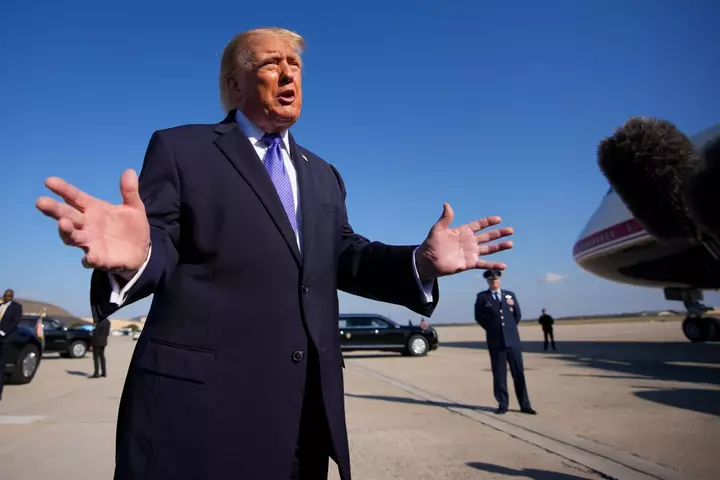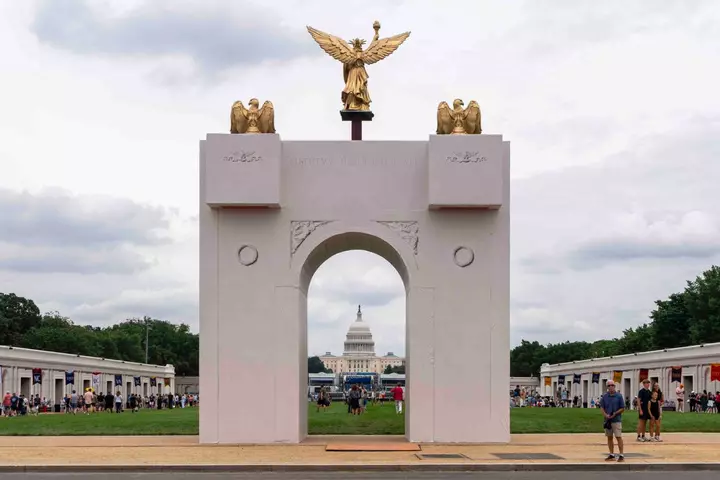
A federal judge is weighing whether to halt President Donald Trump's proposed 250-foot arch near Arlington National Cemetery, after challenging the administration's national security justification. During a Friday hearing, U.S. Chutkan expressed skepticism about the justification and questioned how a tourist attraction near the nation's capital could help protect the president.
"The arch is somehow going to deter assassination attempts on the president?" Chutkan scoffed, responding to the administration's claims that the structure would serve a security function. She also questioned the administration's urgency, asking: "What is the harm of waiting?" and "What is the rush to put this arch up?" Chutkan said she would rule "expeditiously" on whether construction can proceed. The case was brought by three Vietnam War veterans and a historic preservationist, who argue that the project lacks explicit congressional authorization and would negatively affect their experience of visiting Arlington National Cemetery.
The Justice Department is asking Chutkan to dismiss the lawsuit, arguing that the plaintiffs cannot demonstrate sufficient harm to establish their legal standing. The Trump administration hopes to secure approval from a federal review panel on November 5, which would allow construction to begin immediately afterward—if Chutkan does not block the project. Newsweek has reached out to the White House for comment.
During Friday's hearing, Assistant Attorney General Robert Stander defended the administration's plans, describing the proposed arch as "absolutely a high-profile project" and arguing that delays would cause harm to the government. The administration has also invoked national security considerations in its defense of the project. In court filings this week, senior officials argued that the arch could help defend the Washington region, citing assassination attempts against Trump.
However, Chutkan pressed Stander to explain how the structure could simultaneously serve as a major tourist attraction and a military asset. The government has described the arch as a potential destination expected to attract thousands of visitors each day. Stander said he could not provide further details about how the arch would be used for national security purposes, explaining that he and his legal team had only recently learned of the potential military role after Defense Secretary Pete Hegseth and Homeland Security Secretary Markwayne Mullin submitted declarations this week.
"The arch is a generational national defense opportunity to mitigate these evolving threats," Hegseth said in a legal briefing filed Wednesday. "It will be utilized as a dual-purpose structure: a major national monument that also incorporates military utility to support Homeland defense." "This is the first time we've had this information," Stander told the judge. Chutkan questioned why the administration had not been prepared to address the implications, particularly after Trump announced last month that the site would be used as a military complex.
Extract — continue reading at the source.