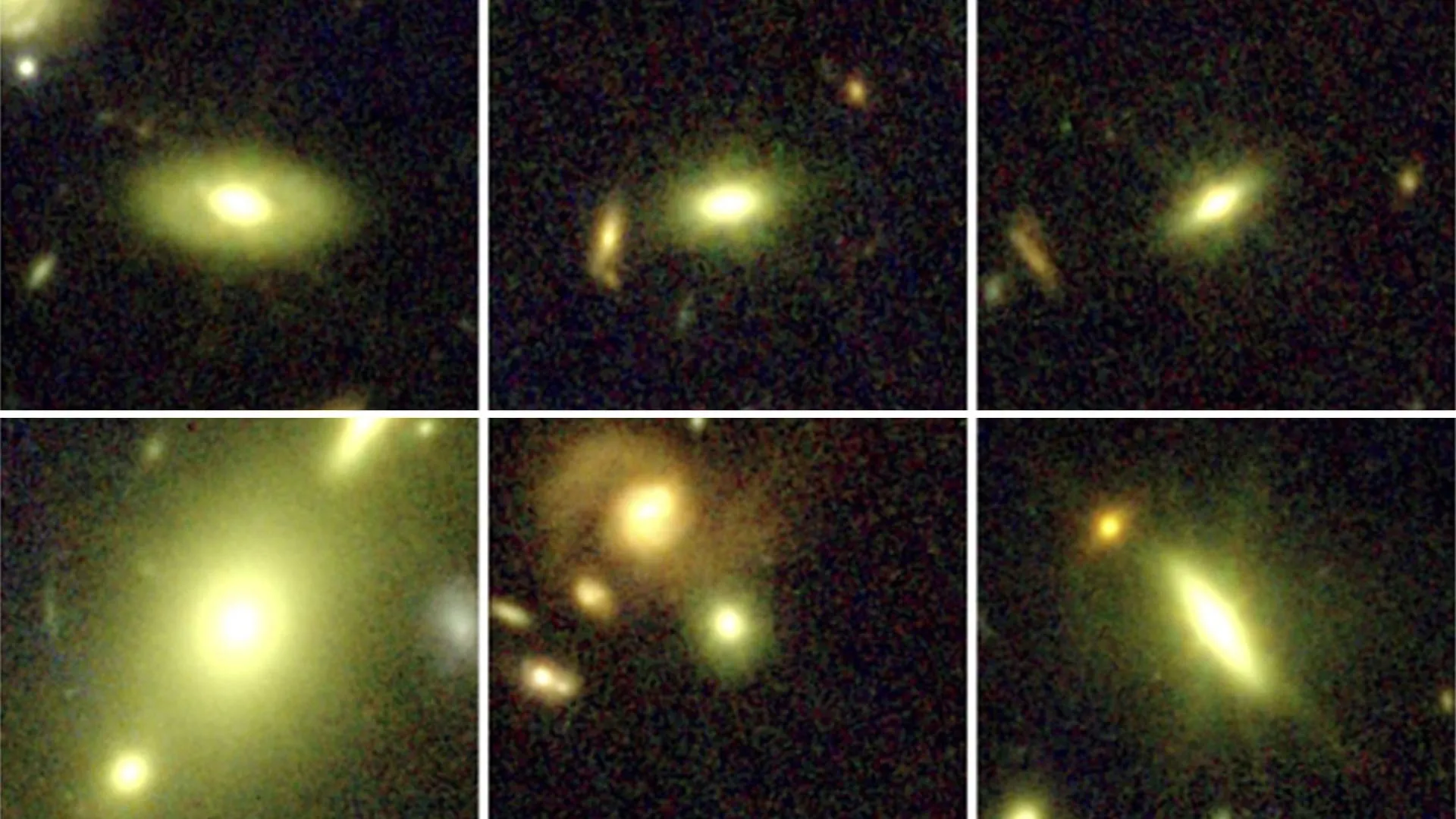
Astronomers have found that some of the largest galaxies in the early universe contained many more small stars than scientists previously realized. That hidden population means these ancient galaxies may have been significantly more massive than earlier estimates indicated. The discovery, made by an international team that included Penn State researchers, adds to a growing challenge for theories about how the first galaxies formed and evolved.
The findings were published in Nature Astronomy. JWST Uncovers Faint Stars in Ancient Galaxies Using NASA's James Webb Space Telescope (JWST), researchers examined nine massive, mature galaxies that stopped producing new stars billions of years ago. They combined JWST observations of the distant universe with earlier ground-based data from the Very Large Telescope.
For the first time, the team was able to reliably estimate the relative numbers of small, faint stars and much larger, brighter stars in galaxies at such great distances. "These galaxies are different," said Joel Leja, the Dr. Keiko Miwa Ross Mid-Career Associate Professor of Astronomy and Astrophysics at Penn State and coauthor of the paper.
"They're different in the way that is really challenging to understand, because they are more massive than we expected -- like a lot more massive, they have three or four times more mass than we expected." Astronomers made the measurements by separating each galaxy's light into a spectrum. Small variations in color within that spectrum can reveal which kinds of stars are present. The difficulty is that large, luminous stars dominate the light, while smaller stars are far dimmer and much harder to identify.
Penn State researchers contributed expertise and guidance for modeling the light detected from the galaxy systems. Bright Stars Can Hide Vast Stellar Populations "If a galaxy were a city, the brightest stars would be the skyscrapers that immediately catch your eye from afar," said lead author Chloe Cheng, a recent doctoral graduate of Leiden University. "Our models demonstrate that a far more numerous population of low-mass stars is concealed by those rare, bright stars, like houses hidden between skyscrapers.
As a result, this galaxy turns out to be much more massive than previous estimates suggested." Traditionally, astronomers estimating the mass hidden in small, faint stars have assumed that stars formed in roughly similar proportions throughout the universe. The new findings challenge that long-standing assumption. The researchers found that the most massive galaxies in the early universe appear to contain a much greater share of low-mass stars than smaller galaxies such as the Milky Way.
Extract — continue reading at the source.


