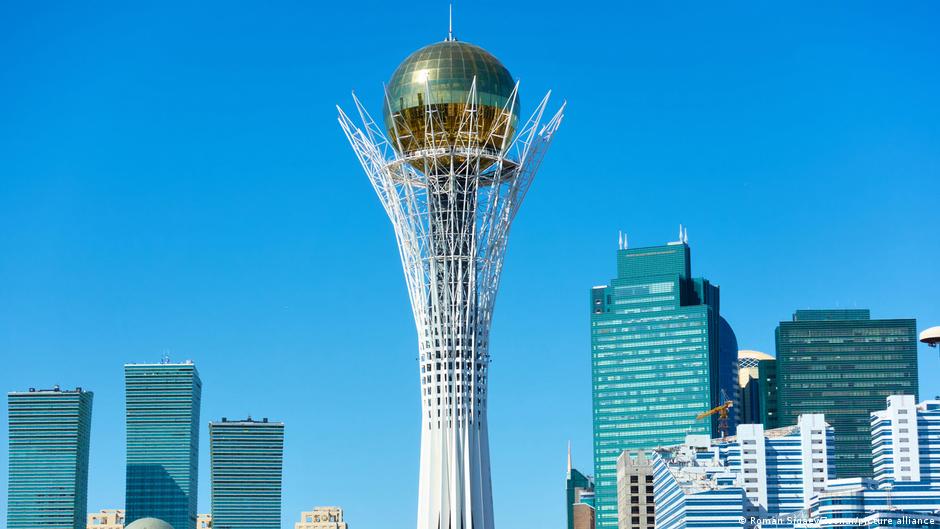
On August 23, Kazakhstan, a former Soviet country that has recently adopted a new constitution, will hold elections to its parliament. The legislative body will be transformed from a two-chamber to a single-chamber system. Citizens will elect 145 members of parliament via party lists.
All seven registered parties have been admitted to the election, including the ruling party, Adilet (which translates to "Justice"). But the election result is the least of the campaign's intrigues. Experts DW interviewed agree that no party other than President Kassym-Jomart Tokayev's Adilet stands a chance of winning.
Luca Anceschi, Professor of Eurasian Studies at the University of Glasgow, Scotland, suggests that the new parliament will do the same as the previous one, "which is pretty much to represent whatever the regime wants them to do." In his view, one should not expect representatives of the genuine opposition to be elected to parliament. Stefan Meister, Head of the Center for Order and Governance in Eastern Europe, Russia and Central Asia at the German Council on Foreign Relations (DGAP), shares this assessment. He says the ruling party is likely to win the election, a scenario also reflected in recent opinion polls.
Both experts agree that these elections are intended to consolidate Tokayev's power and further weaken the bloc led by Nursultan Nazarbayev, the country's president from 1991-2019. Constitutional amendments approved earlier allow Tokayev to seek another seven-year presidential term in 2029 and replace the two-chamber parliament with a single-chamber assembly called the Kurultai. According to former Kazakhstani senator Zauresh Battalova, who now heads the NGO Foundation for the Development of Parliamentarism in Kazakhstan, what matters is not the number of chambers in parliament, but "the scope of its powers, its autonomy and its ability to oversee the executive branch of government." The new constitution has changed not only the structure of parliament but also the way its members are elected.
Independent candidates are no longer allowed to run under the current electoral system. Zauresh Battalova sees this as one of the factors limiting voters' political choice. "The election will be held exclusively on the basis of party lists, in the absence of a political opposition and with limited party competition.
The scope for genuine political choice remains extremely narrow," she told DW. Meister and Anceschi both say that one should not expect any reaction from European Union members or the European Commission to the deterioration in political freedoms in Kazakhstan. Meister points out that, since the start of the war in Ukraine, the EU has adopted a more pragmatic approach towards Central Asian states.
Extract — continue reading at the source.