Boarding the Baku Metro during rush hour, the scale of the challenge is obvious, having experienced it, even for an occasional commuter. In 2025, the network carried 226.8 million passengers, roughly 621,000 per day, down 1.4% from approximately 230 million in 2024. The metro operated across 27 stations and 40.7 kilometres of track, while the number of passenger carriages entering service increased by 9% to 381, according to AZCON Holding's annual report.
Train intervals were shortened by 15 seconds to just one minute and 45 seconds during peak operations. Yet the pressure on the ageing network remains considerable. Under the government's 2025–2030 transport development programme, authorities plan to construct another 10 stations and procure 299 additional next-generation carriages, expanding capacity while gradually replacing Soviet-era rolling stock.
This week saw one of its contestants make an even bolder bid than usual. On October 12th, a group from the Czech Republic representing the Confederation of Industry and Transport, including transport minister Ivan Bednárik, visited AZCON holding in Azerbaijan. Among them were the Chairman of AZCON, Shahin Babayev, Vusal Aslanov of Baku Metro, and Rovshan Rustamov of Azerbaijan Railways.
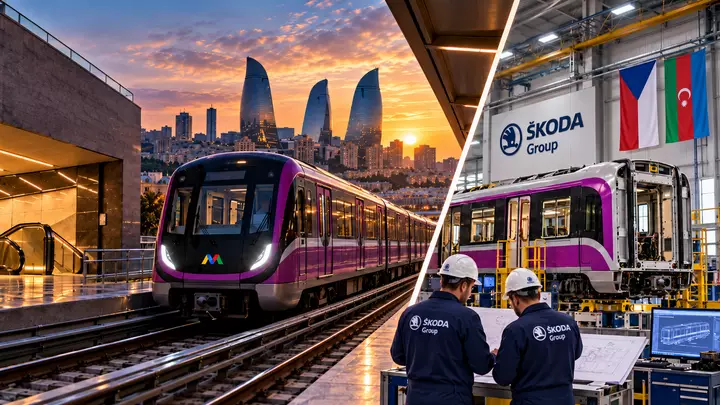
The vice-chairman of Škoda Group, Tomáš Ignačák, presented his proposals for not just trains, but a factory as well. The plan is that of a joint venture with a local partner, developed in stages through local manufacturing and servicing, using local component producers and engineers. "Our ambition is not only to supply modern vehicles but, together with local partners, to build long-term cooperation in servicing, technology and education," Mr Ignačák said.
The long-term goal, as announced by the company, is to have a manufacturing base in Baku able to service other markets in the region. The project is well-suited to the nature of the competition in the rail market. The sale of a train is one-time activity; maintenance over 30 years is the annuity.
The ownership of spare parts, shops and expertise determines the one who gets the profit margin for the lifespan of the train, and who will depend on the supplier in the end. For Azerbaijan, a country that has invested a decade into developing its transportation industry, it seems quite attractive. Škoda indeed has credentials to give it a shot; it has its roots from the works of engineering established by Count Waldstein in 1859 and currently has approximately 10,000 staff members spread out in plants in the Czech Republic, Finland, and Türkiye.
Extract — continue reading at the source.