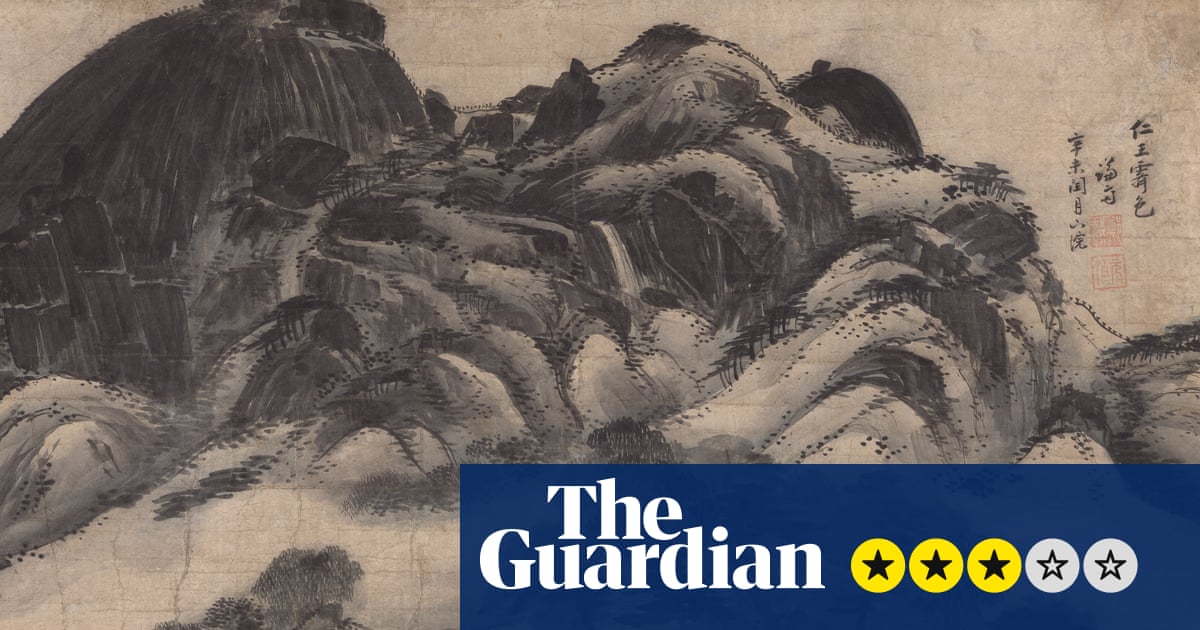
The runaway success of the Bayeux tapestry has put the British Museum in a league of its own, perhaps making it, at this moment, the leading museum on earth – and it’s rapidly following up with Korea, a survey of “2,000 years of creativity” in a land that, before its sufferings in the 20th century, enjoyed millennia of calm, at least to judge from its art. But it’s a blockbuster with a tragic flaw, a lovely broken vase badly stuck together. You are lured at first into a nirvana of beauty.
A giant bronze bell from a Buddhist monastery, cast in the eighth century AD and bulging with dragons, flames and flowery embossments, strikes the tone. It calls you to meditation. A gong adds to the harmony (and if you need that underlining, there are bells and gongs on the now obligatory exhibition soundtrack).
I was held rapt by this Buddhist period in Korea’s history, when the contemplative religion from India interacted with the artistic influence of China to inspire ecstatic hand-copied sutras (spiritual scriptures) and slender little statuettes of bodhisattvas (Buddhist saints who have achieved enlightened holiness). Yet even before Buddhism brought its ethereal aesthetic, the resourcefulness of artisans in the Korean peninsula was staggering. Intricate stoneware objects from as early as the fifth century include a horse standing on a circular plinth with a drinking horn balanced on its back – a practical object of wild beauty.
Ceramics came to Korea from China but took root in creations of fantastic originality. The kingdom of Goryeo, which unified the peninsula from 918 to 1392 and made Buddhism the state religion, sponsored superb courtly ceramics. Potters adopted the green glazed stoneware, celadon, from China’s Zhejiang province and perfected it in smooth pale green bowls and vases that soothe your soul.
A flair for exquisite earthenware continued under the neo-Confucian Joseon dynasty, which ruled from 1392 until, astonishingly, 1897. The most captivating pot from this era is a huge, white, near-spherical moon jar made in the 18th century. It’s an intoxicating blend of scale and geometry created by throwing two semi-circular bowls and joining them together.
You can see the imperfect, dimpled join, cherished in Korean culture, which adds to its uniqueness, its personality. And then the spell is broken. The show shifts forward suddenly, brutally, into some so-so early 20th-century Korean art.
Extract — continue reading at the source.