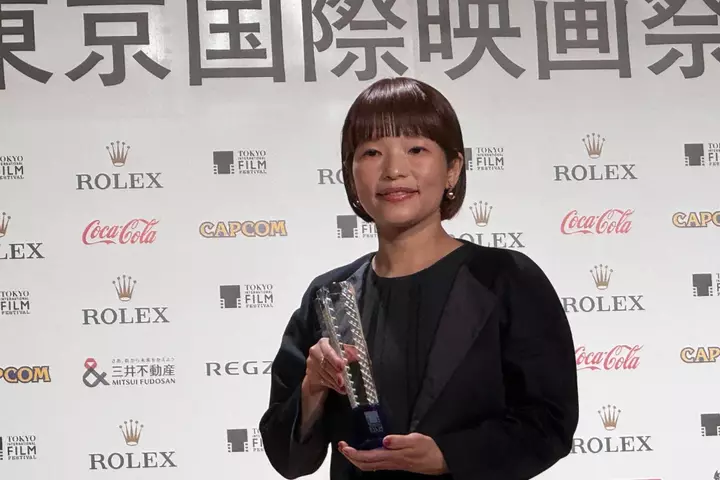
Co-recipient of the 2026 Kurosawa Akira Award together with Iranian filmmaker Mohammad Rasoulof, Korean-Japanese director O Mipo was in an understandably upbeat mood when she met with Variety just before the award ceremony on Tuesday at Tokyo’s Imperial Hotel, under the aegis of the 39th Tokyo International Film Festival. The award honors filmmakers of substantial achievement who represent the future of cinema. O certainly fits that description: Since her industry start as a script supervisor for director Obayashi Nobuhiko, she has accumulated a long list of awards and accolades, beginning with a prize for her short “Eye” at the 2002 Short Shorts Film Festival in Tokyo.
In 2005 her first feature-length screenplay, “The Sakai’s Happiness,” won the Sundance/NHK International Filmmakers Award. Based on this script, she directed her debut feature of the same title. In 2010, her drama “Here Comes the Bride, My Mom!” which she also scripted, won the grand prize for the Shindo Kaneto Awards, which are given to promising directors by a committee of Japanese producers.
Her 2014 drama “The Light Shines Only There” was Japan’s submission for the Academy Award for best foreign language film. After releasing the 2015 drama “Being Good,” O stepped back from features to raise her two sons, though she directed a segment of the 2022 international anthology “Tell It Like a Woman.” She returned to features in 2024 with the coming-of-age drama “Living in Two Worlds” and followed with the 2025 eco-themed children’s drama “How Dare You?” “When I heard that they were going to give me the award my first reaction was just pure surprise – or rather, disbelief,” O says. I wondered if they’d made a mistake.
But I gratefully accepted it, of course. I hadn’t really made any big movies up to that point. I was just so happy that they found me out of all the (directors) in Japan.” The Japanese film industry, she says, is “overwhelmingly different” since she first entered the industry as a crew member in 1999: “There are a lot more female staff members now, and directors too.
That’s definitely the biggest difference.” Also, what she describes as “the system for making movies” has changed. That was my mindset, too, back when I was working as part of the crew.” Now, she explains, “It’s become pretty common for everyone to go through what you might call ‘respect training.’ In terms of rights, everyone is more or less on the same footing – or rather, in the same position.” But while production of Japanese films has been rising – nearly 700 are now released annually – O says she “can’t help but feel that the overseas market hasn’t really taken off yet.” “I have a desire for my films to be recognized overseas,” she adds, “but the Japanese films I always see at film festivals are just… a certain type. So I’d like to see many more films get that chance.” She would also like to follow in the footsteps of Kore-eda Hirokazu, Hamaguchi Ryusuke and other prominent Japanese directors who have made films abroad.
I get asked that a lot: ‘What do you think of working overseas?’ I just come out and say, ‘I want to go to Hollywood someday.’” In addition to making movies, O has long worked as a director of TV commercials and makes no apologies for it. So even if I get offers for commercials, I have to turn them down. Gradually the number of offers dwindles and things have gotten a bit bleak since I’m relying solely on movies.
Extract — continue reading at the source.