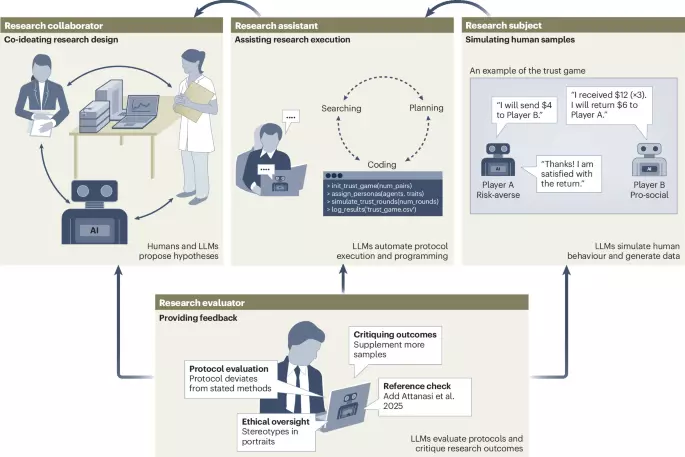
Large language models (LLMs) are transforming computational social science. This Review examines how LLMs now serve four distinct research roles: subjects that simulate human behaviour, assistants that automate analysis, collaborators that generate hypotheses and evaluators that audit and improve research quality. We analyse recent advances across sociology, political science, psychology, anthropology, economics and related fields, revealing how LLMs accelerate discovery while creating new methodological paradigms.
This transformation arrives as society itself becomes saturated with artificial intelligence agents—making LLMs both our research tools and authentic research subjects. Yet fundamental challenges persist. LLMs struggle with causal inference and raise urgent ethical concerns about privacy and misinformation, and their ability to reproduce social complexity remains uneven and unproven.
We identify critical research directions for harnessing LLMs’ potential while addressing their limitations. As artificial intelligence reshapes human society, understanding this transformation requires the very tools driving it—a recursive challenge that will define the future of social science. This is a preview of subscription content, access via your institution Access Nature and 54 other Nature Portfolio journals Get Nature+, our best-value online-access subscription Receive 12 digital issues and online access to articles Prices may be subject to local taxes which are calculated during checkout Lazer, D. et al.
Computational social science. Science 323, 721–723 (2009). Article PubMed PubMed Central CAS Google Scholar Lazer, D.
Computational social science: obstacles and opportunities. Science 369, 1060–1062 (2020). Vosoughi, S., Roy, D. & Aral, S.
The spread of true and false news online. Science 359, 1146–1151 (2018). Exposure to opposing views on social media can increase political polarization.
Extract — continue reading at the source.


