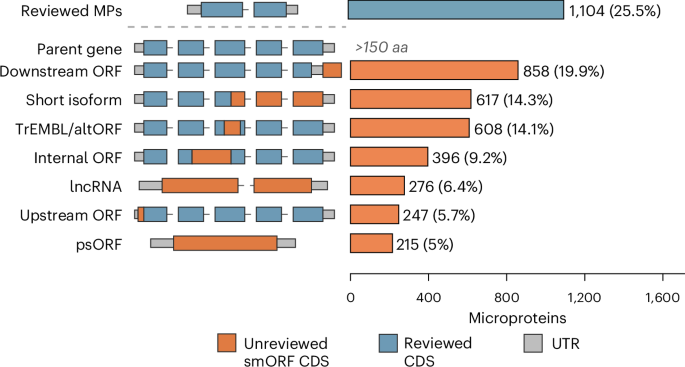
Microproteins, small proteins of 100–150 amino acids, are largely absent from reference proteomes and have been overlooked in brain and aging research. An atlas of the aged human brain catalogs over 1,000 high-confidence microproteins, including one encoded by the MKKS gene that is reduced in Alzheimer’s disease and regulates energy production in microglia. This is a preview of subscription content, access via your institution Access Nature and 54 other Nature Portfolio journals Get Nature+, our best-value online-access subscription Receive 12 digital issues and online access to articles Prices may be subject to local taxes which are calculated during checkout Deutsch, E.
Expanding the human proteome with microproteins and peptideins. Nature 654, 813–825 (2026). This paper reports thousands of translated smORFs and their encoded microproteins across multiple human tissues.
Article CAS PubMed PubMed Central Google Scholar Martinez, T. Accurate annotation of human protein-coding small open reading frames. Biol. 16, 458–468 (2020).
This paper reports fundamental ribosome profiling methods to detect translated smORFs. Peptidomic discovery of short open reading frame-encoded peptides in human cells. This paper shows evidence for microproteins (at the time referred to as short open reading frame-encoded peptides) using a proteogenomics strategy.
Vieira de Souza, E. et al. Rp3: Ribosome profiling-assisted proteogenomics improves coverage and confidence during microprotein discovery. This paper combines ribosome profiling and mass spectrometry in a unified pipeline to discover microproteins that are missed by each method in isolation.
Religious Orders Study and Rush Memory and Aging Project. Alzheimers Dis. 64, S161–S189 (2018). This review describes the datasets provided by the ROSMAP cohorts for fundamental Alzheimer’s disease mechanistic research.
Extract — continue reading at the source.


