Structural synaptic plasticity underlies the changes in brain connectivity required for learning and memory. Inhibitory synapses target all subcellular domains of excitatory pyramidal neurons, including dendrites, somata and axon initial segments. These subcellular domains have distinct molecular, structural and physiological profiles which underlie their functions.
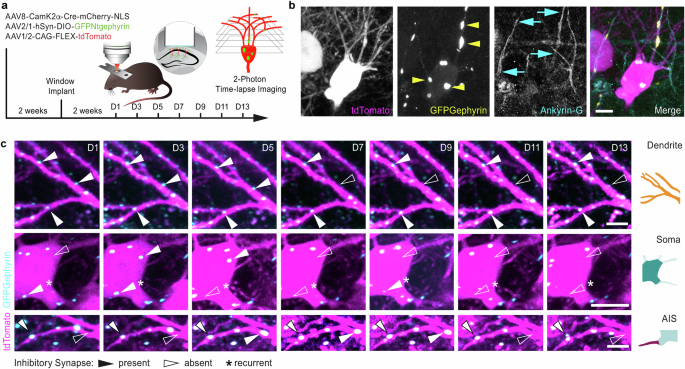
How structural plasticity of inhibitory synapses supports these functions as well as emerging properties such as memory is largely unknown. To tackle these questions we tracked inhibitory synapses on basal dendrites, somata and axon initial segments of pyramidal neurons in the dorsal hippocampal CA1 area of mice over two weeks. Size and temporal dynamics of inhibitory synapses showed a strong compartmentalization.
Trace fear conditioning led to reorganization of dendritic and to stabilization of axon initial segments’ inhibitory synapses. Finally, mathematical modelling allowed us to probe the mechanisms underlying stabilization of inhibitory synapses upon learning. Coordinated changes in synaptic connections give rise to the brain’s ability to learn and recall information1,2,3.
These modifications include strengthening or weakening of existing synapses, as well as synapse formation and elimination. Structural synaptic plasticity underlies long-term changes in connectivity that might be required for learning and memory4,5. Moreover, the interplay between excitatory and inhibitory synaptic transmission serves an important role in adult brain and plasticity of excitatory and inhibitory inputs both participate in the processing and integration of local dendritic activity6,7.
Inhibitory synapses (ISs) target all subcellular domains of excitatory PNs (PNs), including the dendritic arborizations, the soma, and the axon initial segment (AIS)8,9. These subcellular domains have distinct molecular, structural, and physiological profiles which underlie their specific computational functions: dendrites receive and integrate inputs, while somata and AIS provide the cellular output. The function of the different classes of inhibitory neurons (INs) projecting to these subcellular compartments has been the subject of intense investigation10,11,12, yet how the structural plasticity of ISs supports these functions is largely unknown.
Likewise, different classes of INs projecting to different subcellular compartments have been implicated in different aspects of hippocampal learning13,14,15,16,17,18,19,20,21, but if and how structural IS plasticity in these compartments relate to learning has not been established. Longitudinal two-photon (2 P) optical imaging enabled investigating long-term dynamics of excitatory synaptic structural plasticity in the brain of live animals and led to a leap in understanding of brain plasticity and its role in learning and recall22,23,24. By comparison, the structural plasticity of ISs is understudied.
Extract — continue reading at the source.


