Welsh folklore tells of a Roman emperor named Macsen Wledig, who was tormented by visions of a beautiful stranger in a faraway land. According to a 19th-century translation of the Mabinogion, a collection of 11 medieval tales, “Except when he slept, he saw nothing of her, for he knew not where in the world she was.” Macsen’s quest to uncover this mystery woman’s identity eventually leads him to the British Isles, where his beloved lives with her family. In return for her hand in marriage, the soon-to-be empress asks Macsen to conquer “the island of Britain for her father, from the Channel to the Irish Sea, together with three adjacent islands.” Macsen eagerly complies, making his way to the top of Frenni Fawr, a peak in what is now Pembrokeshire, Wales.
Per the Mabinogion, “There the emperor pitched his tent. And that encamping place is called Cadair Maxen, even to this day.” Historians have long known that this legendary figure was inspired by an actual ancient ruler: Magnus Maximus, a general whose troops proclaimed him Roman emperor in the West in the late fourth century C.E. But the events described in the Mabinogion have largely been consigned to folklore—until now.
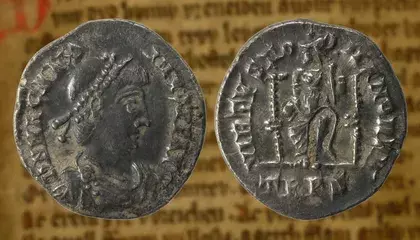
As Dalya Alberge reports for the Guardian, an ongoing excavation led by Mark Merrony, an archaeologist at the University of Oxford in England, has unearthed remnants of a Roman fort in Pembrokeshire, including fourth-century coins, an iron stylus, a game piece and fragments of ceramic tiles. The finds bolster Merrony’s argument that the Romans played a greater role in the region’s ancient past than previously believed. The presence of a heavily fortified Roman auxiliary fort may help unlock the mystery of a Mabinogion legend that has endured for nearly 1,700 years.” Merrony stumbled upon the fort while riding his bike in north Pembrokeshire in 2024.
Early investigations indicate that the stronghold stretched over as many as three hectares, meaning it could have housed around 500 soldiers. In the two years since Merrony’s initial discovery, the archaeologist has conducted a geophysical survey and trial excavations at the site. He and his colleagues had a “breakthrough” in early September, when they found “bases of floor structures built of clay and packed with the remnants of thin stone blocks,” as well as traces of a Roman road, a kiln, flooring consistent with a Roman granary, and assorted artifacts such as pottery shards and a spindle whorl, Merrony writes for the Conversation.
The finds support the theory that the site was once home to a timber auxiliary fort. Merrony doesn’t suggest that Maximus himself constructed the fort. Instead, he argues that Sextus Julius Frontinus, a Roman governor of Britain, established it between 74 and 78 C.E.
Maximus could have used the site centuries later. But if there’s a fort a couple of miles away that’s clearly visible from the peak of the mountain—which it is and would have been—[Maximus] would have not only been able to see it but would have known about it.” As Merrony writes for the Conversation, “The discovery represents an extraordinary fusion between myth and reality and demonstrates that folklore is often underpinned by fact.” Maximus was a Spaniard who commanded Roman soldiers in their fight against the Picts and the Scots. In 383 C.E., Maximus’ men named him Western emperor in place of Gratian, the unpopular ruler who officially held the title.
Extract — continue reading at the source.