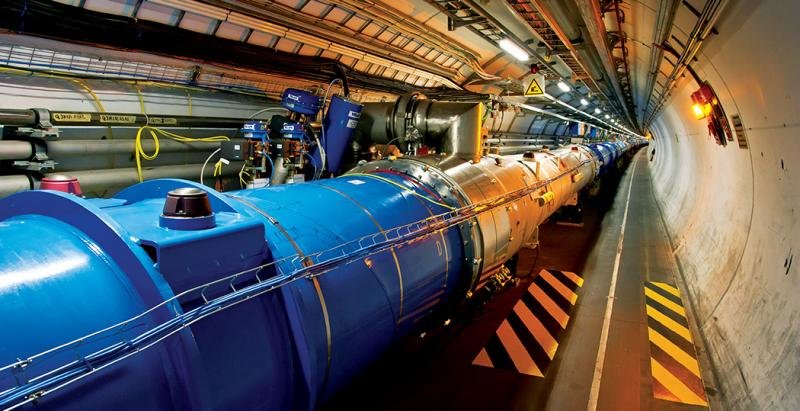
This article has been reviewed according to Science X's editorial process and policies. Editors have highlighted the following attributes while ensuring the content's credibility: Many people are aware that the Large Hadron Collider (LHC) at CERN smashes tiny subatomic particles together at nearly the speed of light to test foundational laws of physics and discover new fundamental particles, but some experiments also help scientists better visualize the actual structure of atoms we are already familiar with, like oxygen and neon. While science textbooks often feature pictures of these and other atoms as if their nuclei are well-defined structures, the reality is more complicated.
A new study, published in Physical Review Letters, reveals new details about the internal structure of oxygen and neon from the flow of particles coming out of oxygen-oxygen and neon-neon collisions in the LHC. Instead of a well-defined structure, the nuclei of atoms actually have shifting, dynamic shapes determined by energy states and governed by probability. When these atomic nuclei collide at very high speeds, they can create an extremely hot, short-lived state of matter called quark-gluon plasma (QGP).
The particles flying out in the form of QGP typically exhibit a collective flow that acts like a liquid with a coordinated preference for certain directions. This flow can provide information about the starting geometry of the collision. Previous high-energy collisions have been used to probe the shapes of heavier nuclei, like uranium.
Similar flow-like signals were also seen in proton-proton and proton-nucleus (pA) collisions. But lighter nuclei, like oxygen and neon, offer a cleaner test of this geometry than heavy nuclei or proton-based collisions. The authors of the new study write, "In contrast to pA collisions, where initial conditions are dominated by event-by-event fluctuations, symmetric collisions of light ions provide better control of the initial collision geometry, since it is determined primarily by the spatial distribution of nucleons rather than the partonic structure of the proton.
This makes symmetric light ion collisions ideal for investigating the final-state collective response in small collision systems." Nuclear calculations in past studies have proposed a tetrahedron-like internal arrangement for oxygen-16 and a more elongated, "bowling-pin"-like arrangement for neon-20. The researchers say that because the two ions have similar mass numbers, they should also have similar hydrodynamic evolution. This means that differences in the flow properties during oxygen-oxygen and neon-neon collisions are expected to primarily reflect differences in initial collision geometry, providing information about their nuclear structure.
The team analyzed these collisions with the CMS detector at the CERN Large Hadron Collider, with 5.36 TeV per nucleon pair. Their measurements were compared with fluid-dynamics simulations that include modern calculations of nuclear structure. Results showed significant elliptic and triangular collective flow in both oxygen-oxygen and neon-neon collisions.
Extract — continue reading at the source.


