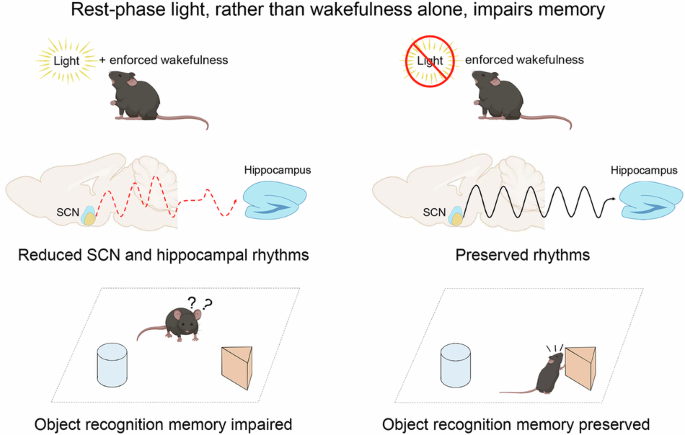
Light exposure in the circadian rest phase is common during shift work and late-night activity, but its effects on memory remain unclear. Using male C57BL/6J mice, we show 6-day rest-phase light exposure (RPL), which combines mistimed light exposure with enforced wakefulness, impairs long-term object recognition memory but not short-delay spatial memory. Behavioral testing, single-nucleus RNA sequencing, and ex vivo electrophysiology show that RPL alters SCN clock organization and output signaling, reduces hippocampal clock-gene rhythmicity, disrupts phase-dependent synaptic gene expression in dentate gyrus and CA1 neurons, and reduces CA1 long-term potentiation.
Maintaining enforced wakefulness without light exposure preserved object recognition memory and CA1 clock-gene expression, showing that mistimed light exposure is required for these effects. Local hippocampal dexamethasone treatment restored day–night differences in hippocampal clock-gene expression and preserved memory under RPL, supporting a role for hippocampal clock-related regulation in memory preservation. Together, these findings show that RPL alters clock-related regulation in the SCN and hippocampus and impairs object recognition memory.
Jufang He and Geoffrey C.Y. Lau (City University of Hong Kong) for providing technical support and discussion, Dr. Ye He (City University of New York Advanced Science Research Center) for helpful discussion, Drs.
Zongli Zheng and Jilin Zhang (City University of Hong Kong) for discussion about snRNA-seq data analysis, and Ms. Qingqing Lu (City University of Hong Kong) for technical support and graphics. Open Access made possible with partial support from the Open Access Publishing Fund of the City University of Hong Kong.
We acknowledge funding from the Research Grants Council of the Hong Kong Special Administrative Region (CityU 11102220 to J.Y.K.), Tung Biomedical Sciences Centre, City University of Hong Kong (9609323 to J.Y.K.), and City University of Hong Kong (7005742 and 7006041 to J.Y.K.). The funders had no role in the study design, data collection or analysis, interpretation of the results, or preparation of the manuscript. These authors contributed equally: Xuebing Zhang, Changwei Yang.
Department of Biomedical Sciences, College of Biomedicine, City University of Hong Kong, Hong Kong, China Xuebing Zhang, Changwei Yang, Wenyi Jin, Liang Zhang, Xingqi Meng & Jin Young Kim Tung Biomedical Sciences Centre, City University of Hong Kong, Hong Kong, China Xuebing Zhang, Liang Zhang & Jin Young Kim Department of Nutrition and Food Safety, School of Public Health, Fujian Medical University, Fuzhou, China Department of Neuroscience, College of Biomedicine, City University of Hong Kong, Hong Kong, China Department of Translational Medicine and Physiology, Elson S. Floyd College of Medicine, Washington State University, Spokane, WA, USA Department of Integrative Physiology and Neuroscience, College of Veterinary Medicine, Washington State University, Pullman, WA, USA Sleep and Performance Research Center, Washington State University, Spokane, WA, USA Steve Gleason Institute for Neuroscience, Washington State University, Spokane, WA, USA The authors declare no competing interests. Publisher’s note Springer Nature remains neutral with regard to jurisdictional claims in published maps and institutional affiliations.
Extract — continue reading at the source.