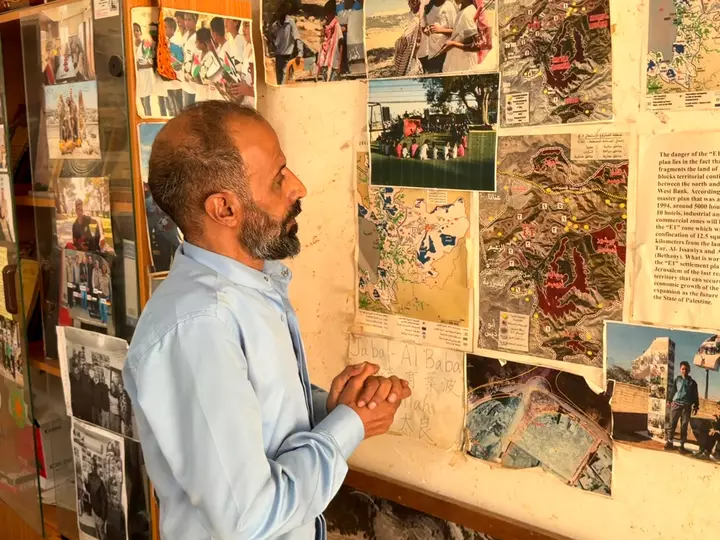
Jabal al-Baba, occupied West Bank – In Jabal al-Baba, a small Bedouin community east of Jerusalem, Israel controls almost every aspect of Palestinians’ daily life, from building homes and accessing water to moving freely. Yet when Israelis head to the polls on October 27, the vast majority of the nearly three million Palestinians in the occupied West Bank will have no say in choosing the government that rules their lives under occupation – unlike the 700,000 Jewish settlers living in some 300 illegal settlements and outposts across the territory, including occupied East Jerusalem. You don’t have the rights that you would have in a democratic state.” About 450 people live in Jabal al-Baba, a community in Area C, which makes up about 60 percent of the occupied West Bank and remains under full Israeli military and civil control.
Many residents here raise sheep and goats beside homes made from corrugated metal. Most belong to the Jahalin tribe, whose families were expelled from the Naqab (Negev) desert region by Israeli authorities in the years after the Nakba, the violent ethnic cleansing of Palestine by Zionist militias in 1948. You are forbidden from building a street.
You are forbidden from building a school,” said al-Jahalin. Israeli rights group Bimkom found authorities rejected more than 99 percent of Palestinian building permit applications in Area C between 2021 and 2024. While Palestinians are restricted from developing, Israeli settlements, which are illegal under international law, are expanding at a record pace.
In April, Israel’s security cabinet was reported to have approved 34 new settlements in a single decision, including outposts legalised retroactively, according to Peace Now, an Israeli anti-settlement watchdog group. For al-Jahalin, the aim is clear: to push his community out and make way for settlers. We have to leave these areas for the benefit of the settlement projects.” In this month’s vote, Israeli Prime Minister Benjamin Netanyahu’s Likud Party and the far-right coalition it leads face a tight race against an opposition alliance consisting of an assortment of parties that are united in their stated aim to “preserve and strengthen Israel as a Jewish and democratic state”.
The opposition grouping has not declared an official leader, but former army chief Gadi Eisenkot, of the centrist Yashar party, is seen as its most likely candidate for prime minister. Recent polls indicate the two blocs are running neck and neck, with neither side appearing on course to win a majority. Most leaders of the Jewish-led opposition bloc, meanwhile, have ruled out joining forces with the Arab-led parties that represent the Palestinian citizens of Israel who make up about 20 percent of its population.
But for many Palestinians, a change at the top would mean little. Jamal Juma’, coordinator of the grassroots Stop the Wall campaign, said decades of occupation have taught Palestinians not to expect a new government to shift fundamental Israeli policies. He pointed out that it was Israel’s centre-left Labour Party – and not the right – that began building settlements in the West Bank after 1967.
Extract — continue reading at the source.