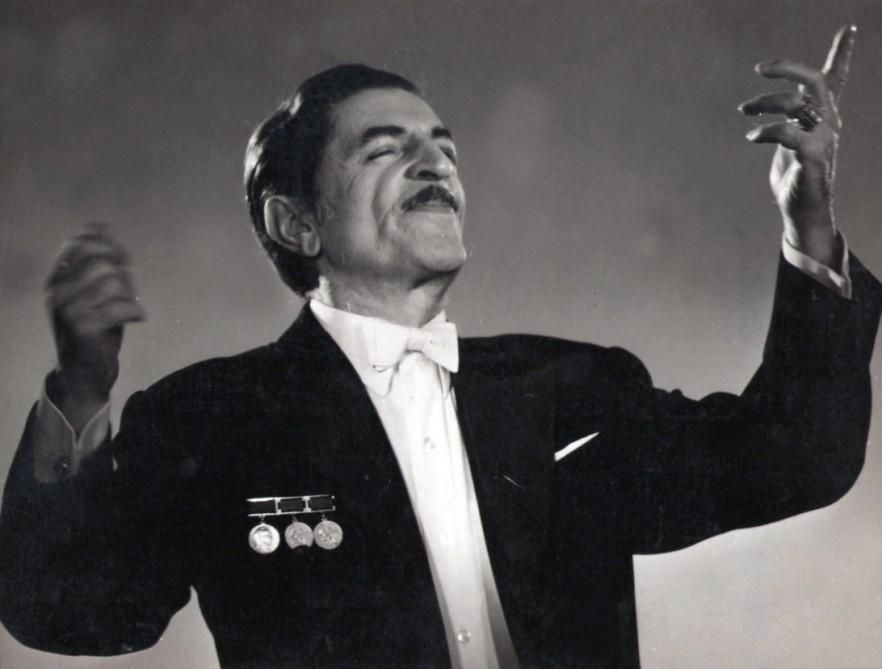
This year marks the 114th anniversary of the birth of renowned Azerbaijani conductor and composer Niyazi Taghizade-Hajibayov. His name became inseparable from the development of Azerbaijan's professional conducting school. Born on August 20, 1912, in Tbilisi, Niyazi grew up in a family where music was part of everyday life.
His father, composer Zulfugar Hajibeyov, and his uncle, the great composer Uzeyir Hajibayli, had a profound influence on his early years. Niyazi's childhood was surrounded by melodies, performances and conversations about music, creating the foundation for a career that would later take Azerbaijani music to major stages around the world. His musical education began in Baku before continuing in Moscow and Leningrad.
From an early age, Niyazi showed a particular interest in conducting. He gradually developed a style of his own, combining the traditions of Azerbaijani music with the discipline and scale of the European symphonic tradition. One of the important moments in his career came in 1938, during the Days of Azerbaijani Art in Moscow.
Niyazi conducted Uzeyir Hajibeyli's "Koroghlu" and Muslim Magomayev's "Nargiz", performances that helped establish his reputation as one of the leading conductors of his generation. For decades, Niyazi was closely connected with the Azerbaijan State Symphony Orchestra. Under his direction, the orchestra performed works by Azerbaijani and international composers and accompanied some of the country's most celebrated singers, including Bulbul, Rashid Behbudov, Muslim Magomayev and Lutfiyar Imanov.
But Niyazi's legacy extends far beyond the conductor's podium. He was also a composer whose works occupy an important place in Azerbaijan's musical heritage. His opera "Khosrov and Shirin," ballet "Chitra", and, above all, the "Rast" symphonic mugham demonstrated his ability to bring together the deep roots of Azerbaijani mugham with the possibilities of the symphony orchestra.
The "Rast" symphonic mugham remains one of Niyazi's most celebrated works. In it, the traditional sound of Azerbaijani mugham takes on a broad orchestral character, creating music that is at once deeply rooted in national culture and accessible to audiences beyond Azerbaijan. Niyazi also believed that music should reach people beyond concert halls.
Extract — continue reading at the source.