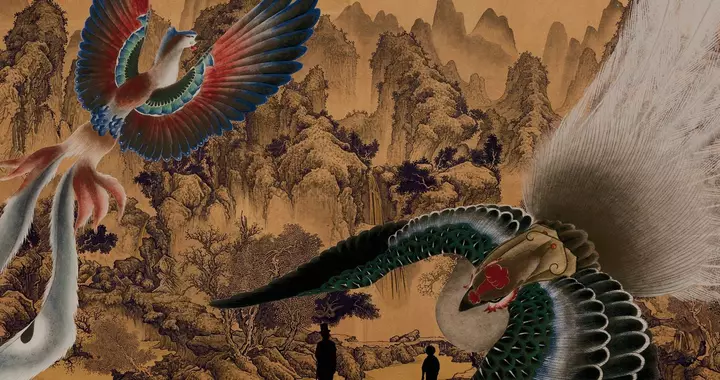
Sun Xun's decade-long project spans different illustration media, different materials, even different dimensions, but it's hard to find a real emotional foothold in the artist's heady and fragmented picture. There’s an increasingly undeniable hunger for the hand-crafted. As discourse around animation becomes more and more absorbed by anaesthetizing questions about AI, it becomes clearer that people who care about the medium are pushing for tactility and foregrounding real texture, materials imprinted with genuine human feeling.
This feels especially true of Sun Xun’s “Magic Atlas,” made over the course of a decade using a refreshingly unrestrained range of different materials and techniques: paint, pen and ink on paper, canvas and newspapers, woodcut, or indeed anything with which the director can bring this strange and dreamlike picture to life. Produced in Singapore by Pi Animation Studio, the film is, to some extent, about a coal empire called Luocha. Ruled by fascist, industrialist despots, it is explored from the perspective of an orphan boy named Xiao Zhi who is granted access to its secrets by an imprisoned magician, incarcerated for giving people some measure of freedom back: the memories taken from them by this government.
Plot honestly feels secondary to “Magic Atlas,” which, despite a brief running time, is rather relaxed about getting Xiao Zhi’s story under way, opting to build the mood of the piece through its fluctuating, inky illustrations instead. (In fact, Xiao often disappears from the film, not long after he appears to question the state of the world as he has been taught to view it.) The appeal of the film is predicated on one’s fondness for the imagery, and perhaps one’s patience for frequently opaque, fragmented, oddly paced storytelling. It opens with the Avatamsaka Sutra, the Buddhist scripture about “the past, the present, the future lying in the present,” followed by a sequence consumed by waves where painted creatures tussle. A narrator (voiced by the director) claiming to be “everywhere, with no beginning and no end” ponders his place in the universe as the style of the art shifts to aged pages and painted backgrounds in black ink.
Surreal hybrid animals (including a horse with a camera for a head) prance across the landscape, impossibly, drawn with white lines on a black background. And then the style shifts again: blue water, a black whale, exploding into more kaleidoscopic paintings which fly through what appear to be homages to Pieter Bruegel. It’s a curious mix of eras, symbols, deities and animals all coalescing in one place, the invasiveness of the regime immediately apparent in how aggressively a factory juts from the more gently painted mountain landscape.
Abstract electronic tones in the score create further dissonance in this surrealist fever dream of a picture as the scenery and style change to meet the needs of the moment. Sun’s piece mostly orbits a monochrome palette of heavy, inky black shading (with white outlines) and a lot of line detail, with broad, impressionistic brushstrokes characterizing the landscape — at least some of the time. But it’s never truly exact or particular about any one style, constantly breaking free of the oppressive obsidian lines that build its authoritarian setting.
The next scene may totally turn that palette on its head with an explosion of colour and an embrace of a more “western” painting style, or another segue into pen and pencil on paper. Throughout, cutting back and forth between scheming politicians in backrooms, foreboding factory lines and a natural world suffering both, Xun mixes almost cartoonish expression with the intense detail of painting. There’s little ambiguity about this mix of folkloric imagery with science fiction: The generals’ Orwellian nature couldn’t be more apparent than in the moment they declare, “You have practiced criminally outmoded thinking” — to a child they charge with having “possession of false memories.” (Or rather, the memories the government permits people to have.) The blatant suppression of truth is, at least, an easy theme to relate to in the present moment.
Extract — continue reading at the source.