It’s much harder to get a handle on him than such supposedly difficult modern greats as Cézanne or Picasso. After all, cubism is a perfectly rational attempt to capture the complexity of reality. He confronts you with wilful mysteries.
This show sets choice examples of his magic against modern art and is full of quirky, unexpected treasures that give your wonder at Magritte little twists in new and perverse directions. A painting of puffy white clouds held me across the gallery and still floats ineffably in my mind. It’s a shock because it is so painterly and subtle.
If you think Magritte fashioned his surrealist images in a deliberately flat, even banal style, think again. This simple painting of clouds in the blue is full of supple shadow and ethereal light, a brilliantly observed view of nature in the vein of Gainsborough, Constable or Hockney. Innocent as these clouds look, real as they look, they are no such thing.
And the painting’s sunniness is totally undermined by its title: The Curse. Magritte made it in 1931 at the height of surrealism, the revolutionary art movement that took from the psychoanalytic writings of Sigmund Freud the insight that nothing is innocent and no image is simply what it seems. Everything can be a symbol and probably a dirty one.
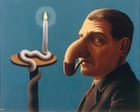
Magritte’s 1936 self-portrait The Philosopher’s Lamp combines both in an absurd meta-Freudian image as his nose becomes a fleshy tube curving down into the bowl of his pipe while a candle twists in a waxy, snaking motion around the stiff single leg of the table. Freud would surely diagnose a fear of impotence but the painting makes that so obvious, it’s a joke. Magritte is satirising psychoanalysis and surrealism itself for being too logical in their reading of symbols.
The surrealist movement was started in Paris after the first world war by poets and artists traumatised by its mass slaughter and seeking imaginative renewal by escaping into dreams and erotic reveries. Magritte became the movement’s greatest Belgian representative, but he pushed at its limits, taking it to a far less easily decoded level. That philosophical shift is here in The Interpretation of Dreams, a modern masterpiece lent by its owner the great (and philosophical) American artist Jasper Johns.
Extract — continue reading at the source.