In medieval Italy, it was accepted wisdom that anyone walking near a swamp risked falling ill from “bad air” — mala aria. Victims were struck with fever, headache, nausea, and chills, and occasionally the illness escalated to vomiting, jaundice, and death. Today, we still call this affliction malaria.
For much of human history, it has ravaged populations in humid tropical and subtropical regions, killing untold numbers. In the 20th century, it was responsible for up to 5% of deaths worldwide; it still kills approximately 600,000 people each year. What malaria was and how it infected humans was deeply mysterious until barely 150 years ago.
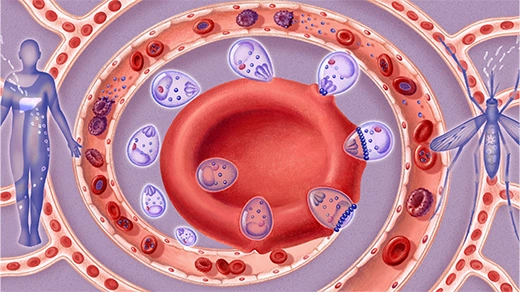
In 1880, the French physician Charles Louis Alphonse Laveran peered at a sample of a soldier’s blood through a crude microscope and discovered the true cause of the disease: not miasma, but a genus of shape-shifting single-celled protists called Plasmodium. Since then, scientists and doctors have described in precise detail the parasites’ life cycle, hosts, and disease progression, and even the nuances of various Plasmodium species, which present slightly different forms of the disease. But some crucial aspects have remained a mystery.
For example, Plasmodium invades human red blood cells as part of its life cycle. To get in, the microbe creates a ring-shaped structure called the moving junction, which briefly creates a gap in the cell membrane it can slip through. The gap then disappears without a trace.
It opens and closes so rapidly, at such a small scale, that imaging technologies couldn’t capture it. Researchers had no clue what the portal structure actually looked like. Her team found that when the Plasmodium parasite installs molecular gaskets in the host cell, it radically remodels the cell membrane to slip through without a trace.
This knowledge could help inform the next generation of malaria treatments and influence the drug-discovery process for other parasitic diseases, such as cyclosporiasis and toxoplasmosis. This is biophysics.” The history of malaria research has paralleled advances in microscopy, from the development of simple light microscopes like the one Laveran used to the cutting-edge cryo-electron techniques of Ho’s lab. This is because the cells the microbes invade are extremely tiny — and the parasites are even smaller.
Extract — continue reading at the source.