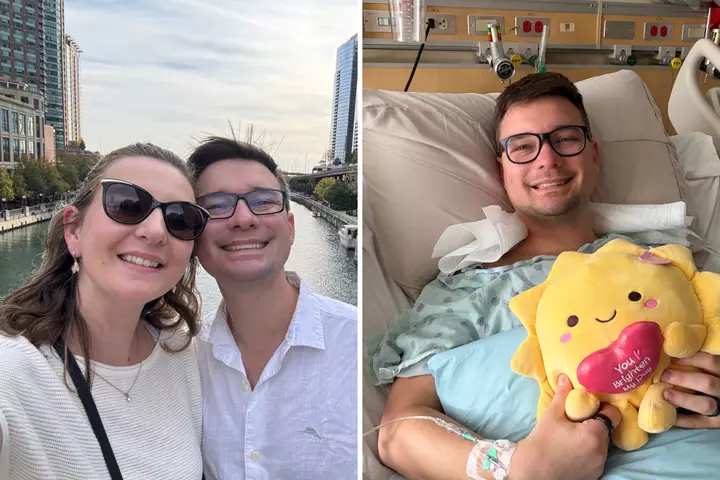
A colonoscopy isn’t anything out of the ordinary for Mitchell Ferguson, who has lived with a chronic inflammatory bowel disease since childhood. So, when the 28-year-old went for the procedure in January, he didn’t think anything of it, despite experiencing blood in his stool and increased bowel movements. "I have dealt with bowel issues for my entire life," Ferguson, from Ohio, told Newsweek.
"Nothing felt out of the ordinary. I thought it was just an ulcerative colitis flare-up." Ferguson was diagnosed with ulcerative colitis, the most common type of inflammatory bowel disease, when he was 10. The condition affects the inner lining of the colon and rectum.
People with longstanding ulcerative colitis are often advised to undergo regular colonoscopies because chronic inflammation can increase the risk of colorectal cancer. Studies have found that people with ulcerative colitis have a higher risk of developing colorectal cancer, particularly the longer they have the condition. During a colonoscopy in January, doctors discovered a 3-centimeter growth.
Ferguson had his colon removed in March, along with 190 lymph nodes, which were biopsied. Cancer was found in four of the nodes, leading to a diagnosis of stage 3 colon cancer. This means the disease had spread to nearby lymph nodes but not to other parts of the body.
"The diagnosis was the hardest day we’ve ever had," his wife, Katelyn Ferguson, 27, told Newsweek. "We thought it would be stage 1 if anything." Ferguson said his doctor was shocked by how quickly the cancer had developed, as it had not been there in 2025. According to the Cleveland Clinic, most colorectal cancers develop from polyps, with the process typically taking around 10 years.
"It seems to have popped up out of nowhere," Ferguson said. "We are still curious to know how it grew so quickly." The cancer diagnosis was just one of several challenges the couple faced. On the day of Ferguson’s first oncology appointment, they had to put down their cat because of liver and gallbladder issues.
Extract — continue reading at the source.