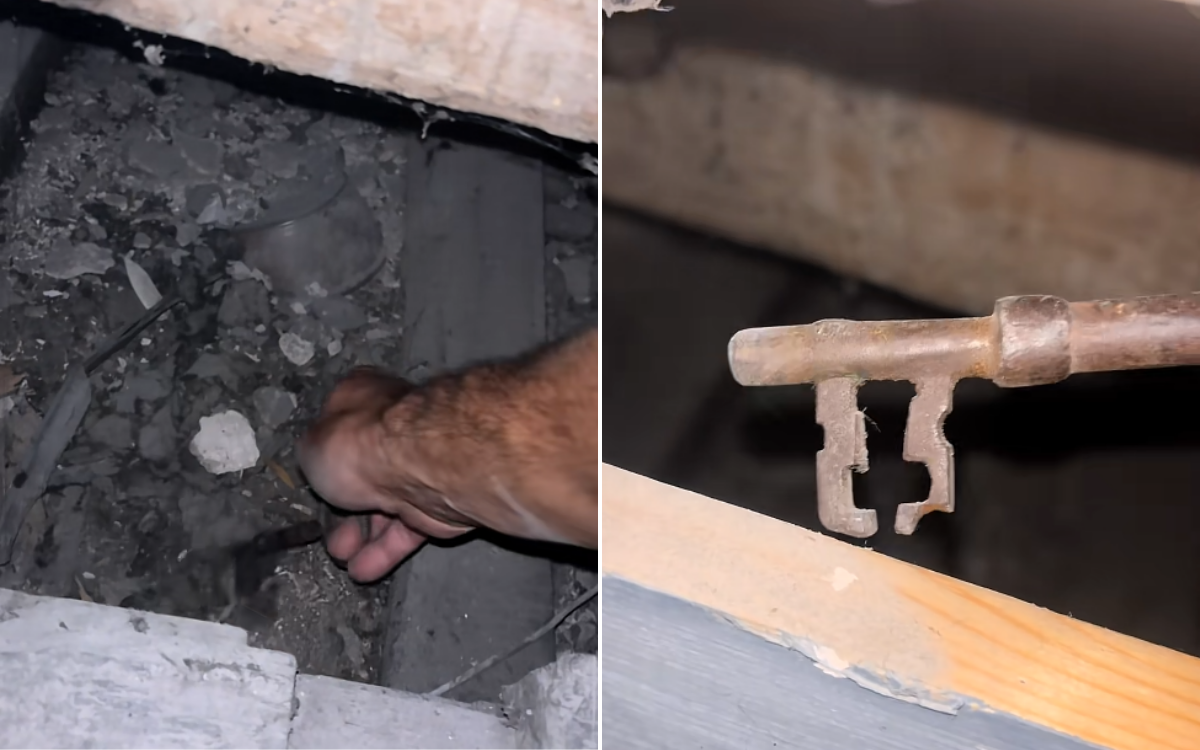
When a homeowner decided to explore the space underneath the floorboards of his 17th-century property, he was shocked to discover something hidden there: a key. Everybody loves a good mystery. In his 1994 study, The Psychology of Curiosity: A Review and Reinterpretation, psychologist George Loewenstein put forward what he termed the "information-gap theory." Loewenstein argued that people become especially curious about a particular subject when they identify a gap between what they know and what they want to know.
Unsolved mysteries tap into this instinct. They are compelling because they present a version of that gap and motivate us to close it. James lives on an estate in the English countryside.
It lies somewhere in the Midlands region, though James has asked that his surname and precise location be omitted from this story. "We have been here for about 15 years," he told Newsweek. "I love it for the beauty of the estate, the setting, and the surrounding parkland." In recent years, James has been offering glimpses of his home on TikTok, posting videos under the handle @englishcountryestate.
One day, James decided to show viewers what lay underneath the floorboards of his centuries-old home. "There's always been a void accessible from the side, so it was really just curiosity to see what was under there," he said. He never expected to find anything.
However, as the torchlit camera panned across the dark space, a shape came into view. "Initially, I didn't know it was even a key. I thought it was a door handle, but I suppose I was intrigued," James said.
In 17th-century England, country estates ranged from modest manor houses to grand aristocratic residences, and security was an important practical concern. Doors were commonly secured with substantial iron locks, often using warded mechanisms in which internal wards prevented an incorrectly shaped key from turning the lock. More sophisticated locks could incorporate multiple wards or additional bolts, while heavy timber doors and iron fittings provided further protection.
Extract — continue reading at the source.