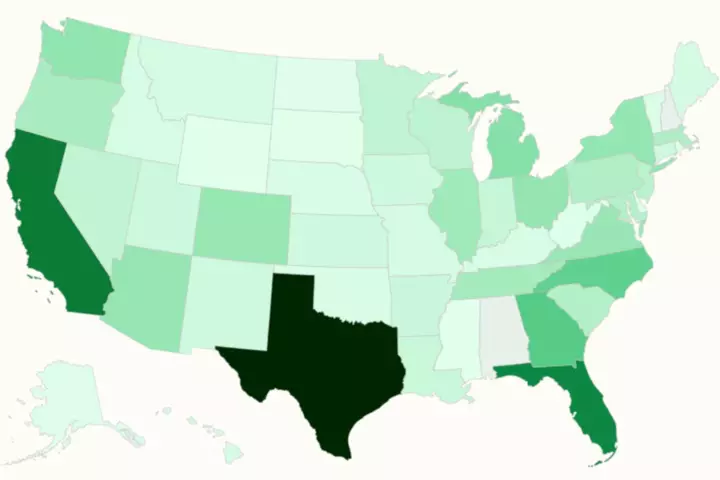
Millions of Americans have already cast ballots in midterm elections that will determine control of Congress, with several states reporting especially high turnout as early in-person voting enters its final days. By Saturday night, more than 52.7 million early votes had been cast nationally, including approximately 29.1 million in-person votes, according to the University of Florida Election Lab. Texas, California, and Florida lead the pack in terms of early votes, with 7,630,789, 5,504,307 and 5,148,276 cast in each state respectively, according to the Election Lab’s most recent figures.
Georgia and North Carolina follow, with 2,823,265 and 2,612,250, respectively. Some states have seen early voting reach record levels. More than 2.8 million voted early in Georgia before its period ended on Friday, the Election Lab’s figures show, surpassing a previous midterm record set in 2022 of roughly 2.5 million early ballots.
In South Carolina, the state’s Election Commission announced Monday a new record had been set for early voting in a gubernatorial election, with the nearly 564,000 ballots cast as of 3 p.m. local time that day surpassing the 561,563 cast early in 2022. The state’s all-time record was set in the 2024 Presidential election, when 1,471,663 ballots were cast early, according to South Carolina’s Election Commission. The Election Lab’s latest figures for South Carolina show 986,460 early votes have been cast.
Early voting has already reached a national midterm record, with the 52.7 million ballots cast before Election Day, surpassing the previous high of 45.9 million set in 2022. As Newsweek previously reported, registered Democrats lead among early voters in the available data, although only slightly more than half of states report registration breakdowns, limiting how far the figures can be treated as representative of nationwide trends. The figures come as early voting deadlines arrive across the country, and in some states they have already ended.
Forty-seven states and the District of Columbia allow for universal early voting, with Alabama, Mississippi and New Hampshire the exceptions. Early in-person voting schedules vary considerably by state, according to the Center for Election Innovation & Research (CEIR). Some concluded on October 27, while 14 states continue through November 2.
Eight states allow or require some local early-voting sites to remain open on Election Day, according to CEIR. Michael McDonald, the University of Florida political science professor who runs the Election Lab, cautioned in comments to TIME against treating early-voting data as a predictor of election outcomes. He said the figures can nevertheless offer valuable information about voting behavior.
Extract — continue reading at the source.