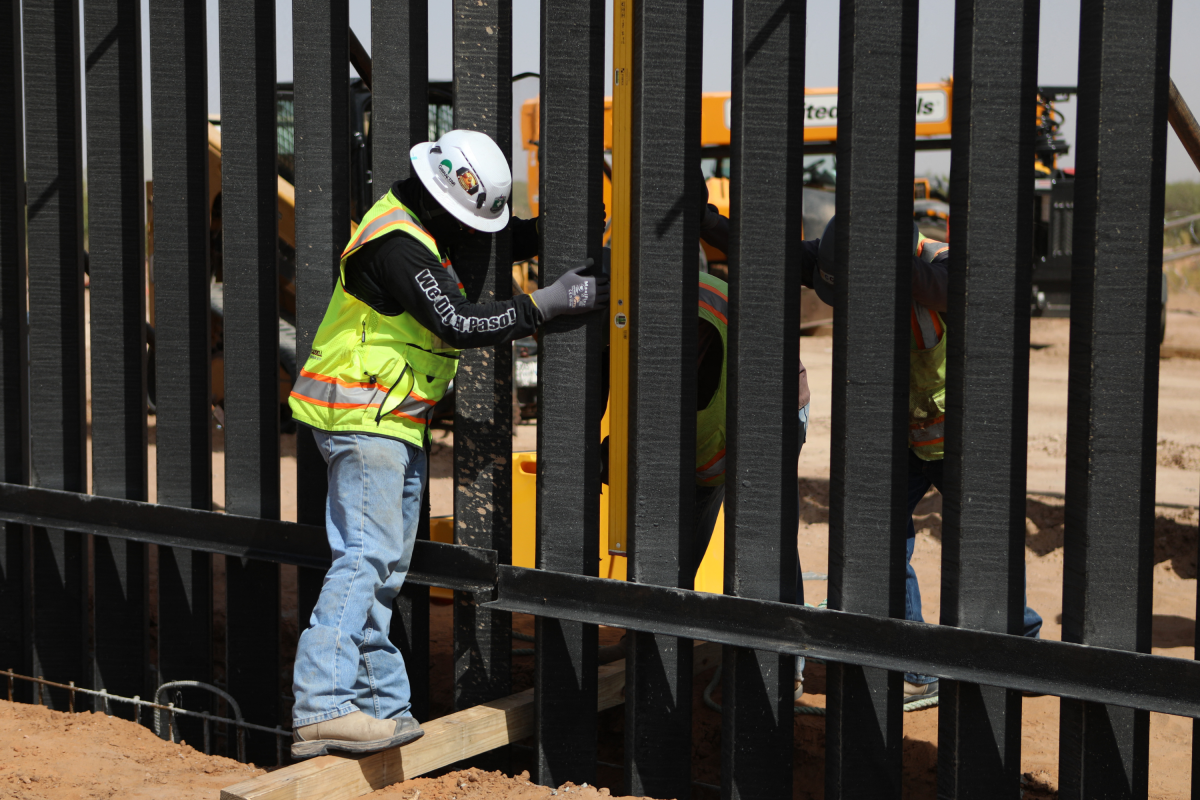
New panels for the border wall are being installed in West Texas, marking the start of visible construction on a 47.3-mile project in the Big Bend region as President Donald Trump’s administration expands its barrier network along the southern border. Customs and Border Protection (CBP) said the first panels for the Big Bend 1 project in Hudspeth County went up on September 15, the first reported. Work is beginning amid legal challenges and resistance from landowners concerned about the federal government’s plans for the remote region.
The development gives new significance to CBP’s Smart Wall map, which records 232.4 miles of various border infrastructure completed since January 20, 2025, and shows hundreds more moving through design or construction. Newsweek contacted CBP on Saturday morning via email for further comment. Trump directed federal agencies in January 2025 to construct temporary and permanent physical barriers supported by personnel and technology.
CBP said it is using $46.5 billion from the One Big Beautiful Bill Act to develop what it calls the “Smart Wall.” The latest work extends that program into a part of Texas where rugged terrain and private ownership have historically limited continuous fencing. CBP’s plans can affect landowners, border communities and visitors to public spaces through new walls, roads, surveillance equipment and vehicle barriers. Big Bend 1 is one component of CBP’s plan for approximately 175 miles of primary barrier across Hudspeth, Jeff Davis and Presidio counties.
Agency planning documents say the system may include surveillance cameras, lighting, fiber-optic and power cables, utility shelters, and access and patrol roads. Work has moved forward first near Sierra Blanca, east of El Paso. The other two primary wall projects shown on CBP’s map cover 62.2 miles and 56.3 miles respectively, but reporting published on September 18 said construction had not begun on those Presidio County sections.
Access to private land presents a significant complication. Some property owners are challenging the administration’s use of eminent domain and environmental-law waivers, potentially leaving the government able to build on certain parcels but not others. Clara Bensen of the No Big Bend Wall coalition told The Guardian that officials were moving forward even though “the plan is not fully baked,” while land disputes complicate efforts to construct a continuous barrier.
Newsweek reached out to the campaign group for further comment via email on Saturday morning. Bob Krumenaker, a former Big Bend National Park superintendent who chairs Keep Big Bend Wild, said in The Guardian opposition had crossed party lines: “I’m very optimistic that there is a lot of support for Big Bend. This is a nonpartisan issue.” A coalition of West Texas landowners has also filed a federal lawsuit shortly before the construction update, seeking to stop projects across the region.
Extract — continue reading at the source.