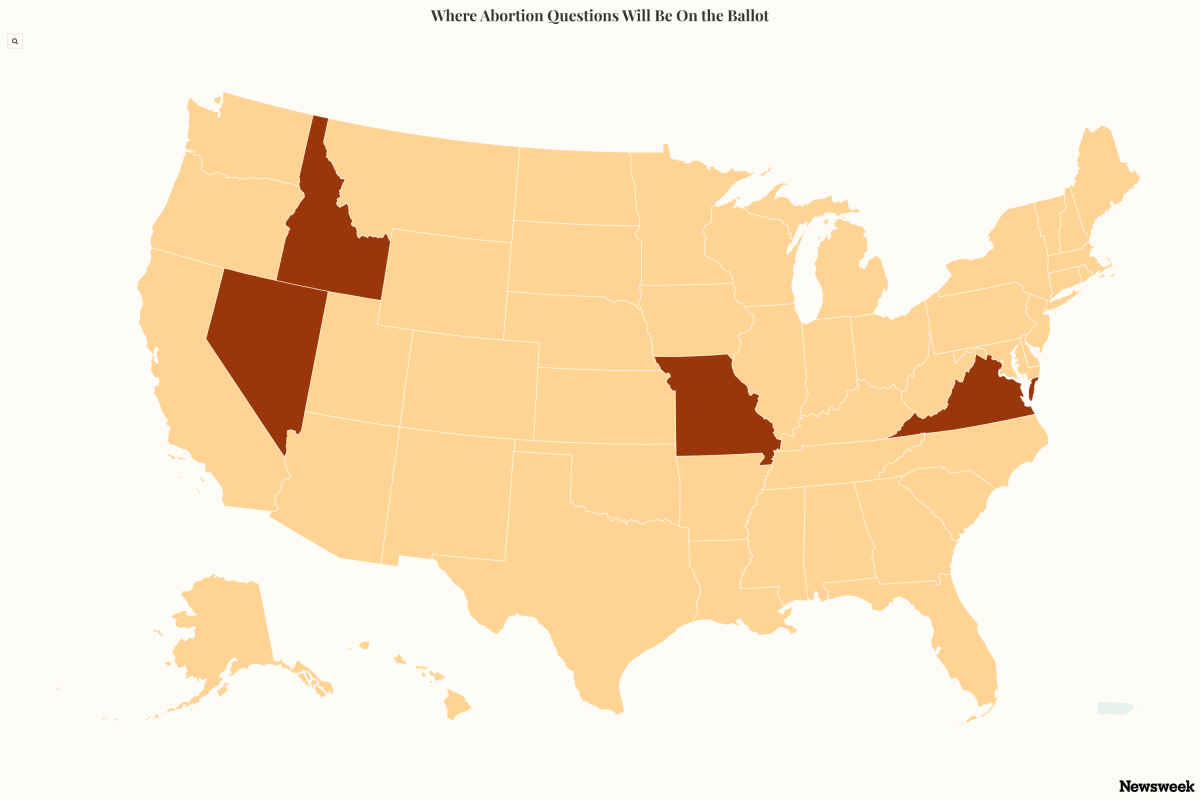
Voters will be prompted to answer an abortion-related question on the ballot in four states during the upcoming midterm elections. Three of the measures are looking to protect abortion rights, whereas the fourth is looking to repeal a constitutional amendment passed in 2024 and ban abortion unless medically necessary. The measures are the most recent to pose the issue to voters since the Supreme Court overturned Roe v.
Wade in 2022, returning authority over abortion policy to the states. Since the Dobbs decision, more than a dozen states have posed the issue to voters at the ballot box. "Since the Supreme Court’s 2022 Dobbs ruling, state ballot initiatives have become a powerful tool used by advocates on both sides hoping to either protect or limit abortion access in their state," KFF, a non-partisan health policy research, polling and news organization, said in a brief published last week.
"Successful ballot initiatives that enact state constitutional amendments provide stronger legal authority to either protect or restrict abortion than laws enacted by the legislature or state Supreme Court rulings." The four states with abortion-related questions on their ballots are Virginia, Nevada, Idaho, and Missouri. A full breakdown of the measures is as follows. In Virginia, voters will be asked whether they believe the state constitution should be changed to protect the right to abortion, as well as other reproductive topics such as postpartum care, birth control, and fertility care, among others.
If the measure passes, healthcare staff and patients would be protected from punishment regarding abortion and other reproductive issue decisions. There would be restrictions for abortion during the third trimester of pregnancy unless the mother's health was at risk or the pregnancy was unviable. According to the Virginia Department of Elections, voters will answer the following question on the ballot: "Should the Constitution of Virginia be amended to (i) protect the freedom to make personal decisions about prenatal care, childbirth, postpartum care, birth control, abortion, miscarriage management, and fertility care; (ii) protect doctors, nurses, and patients from being punished for these decisions; and (iii) allow for restrictions on access to abortion during the third trimester of pregnancy except when the patient's health is at risk or the pregnancy cannot survive?" There are currently no explicit protections regarding a citizen's right to reproductive freedom in the Virginia Constitution, "nor does it explicitly protect or prohibit certain kinds of health care procedures or decisions," the Department of Elections said.
In Nevada, a question that was originally on the 2024 ballot will return this year, as state constitutional amendments must be approved twice over even-number election years in order to take effect. The question will ask voters: "Should the Nevada Constitution be amended to create an individual’s fundamental right to an abortion, without interference by state or local governments, whenever the abortion is performed by a qualified healthcare professional until fetal viability or when necessary to protect the health or life of the pregnant individual at any point during the pregnancy?" In 2024, the question passed with nearly 65 percent of the vote, according to Ballotpedia. Currently, abortion is legal up to 24 weeks in Nevada.
In Idaho, voters will be asked whether they agree with a measure that would create the right to abortion. A "yes" vote supports the right to abortion before fetal viability, where a "no" vote would mean the voter wishes to keep Idaho's current law as is, in which abortion is illegal at any point in the pregnancy except for when the mother's life is in danger or in cases of rape or incest reported to law enforcement during the first trimester. The question on the ballot will read: "Measure creating right to abortion before fetus viability, and post-viability to protect health; right to privacy; healthcare provider liability protections." As it currently stands, abortion is banned in Idaho.
Extract — continue reading at the source.