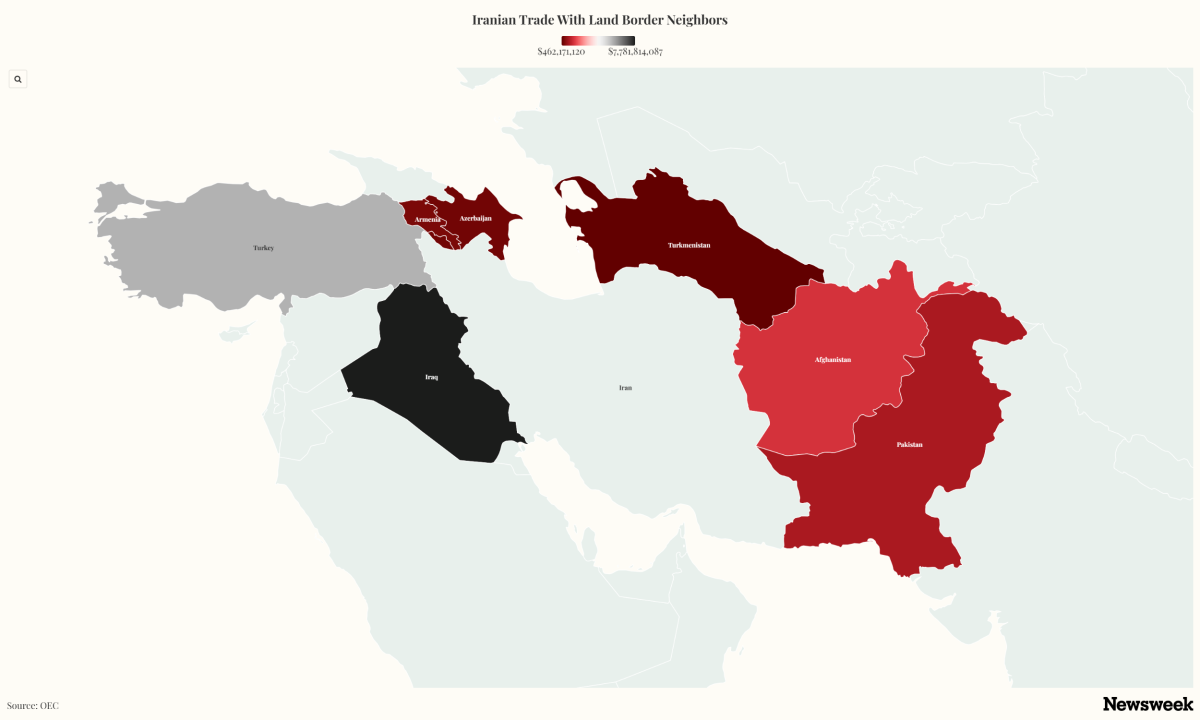
With President Donald Trump threatening to launch an "economic D-Day" against Iran, one of the Islamic Republic's most important wartime lifelines is its geography. And while the resumption of a U.S. naval blockade last month has substantially limited Iran's maritime trade, land routes are becoming an increasingly vital source of commerce. Located at the crossroads of the West, Central and South Asia, Iran shares land borders with seven nations.
Each has its own complex history of ties with Tehran, yet they provide unique corridors for trade less susceptible to interception than sea transit. These routes may not replace Iran's lucrative maritime trade, but they can help fuel a "resistance economy" fighting to survive the latest U.S. economic onslaught. "The biggest change since the war is that these routes are no longer just about regional commerce," Umud Shokri, a senior visiting fellow at George Mason University who specializes in energy and trade networks, told Newsweek.
"They have become part of Iran’s economic-survival strategy. Tehran is trying to shift more trade toward land borders, railways, northern ports, and the Caspian." "But there are limits," he added. "Trucks, railways, and smaller northern ports cannot match the scale and efficiency of maritime trade.
They can help keep food, consumer goods, and some industrial inputs moving, but they cannot fully replace what Iran has lost through disrupted sea routes." Iraq is generally considered Iran's most important neighbor for trade. They also share their longest border at nearly 1,000 miles. Ties between Tehran and Baghdad improved substantially after the fall of longtime Iraqi President Saddam Hussein to a U.S.-led invasion in 2003.
However, Iran's influence has proven divisive, especially given its patronage for powerful Shiite Muslim militias that have fought both Sunni Muslim jihadis as well as U.S. troops, all the while consolidating political power. These groups accelerated their targeting of U.S. and Israeli forces when the ongoing Middle East crisis first erupted with the outbreak of the war in Gaza in October 2023. More recently, they've focused their efforts on Saudi Arabia and the United Arab Emirates, creating a new front for Iran and its Axis of Resistance to raise the costs of the U.S.-Israeli war launched in February.
Iran-Iraq ties also have a key economic element, with their trade volume exceeding $10 billion last year. For Iran, the relationship provides an outlet to major markets and connectivity to the rest of the Middle East and the Mediterranean, while Iraq relies heavily on its neighbor for natural gas and electricity. Washington also considers Baghdad to be a partner; however, any concerted U.S. effort to choke off trade with Iran would likely have severe effects for Iraq.
Extract — continue reading at the source.