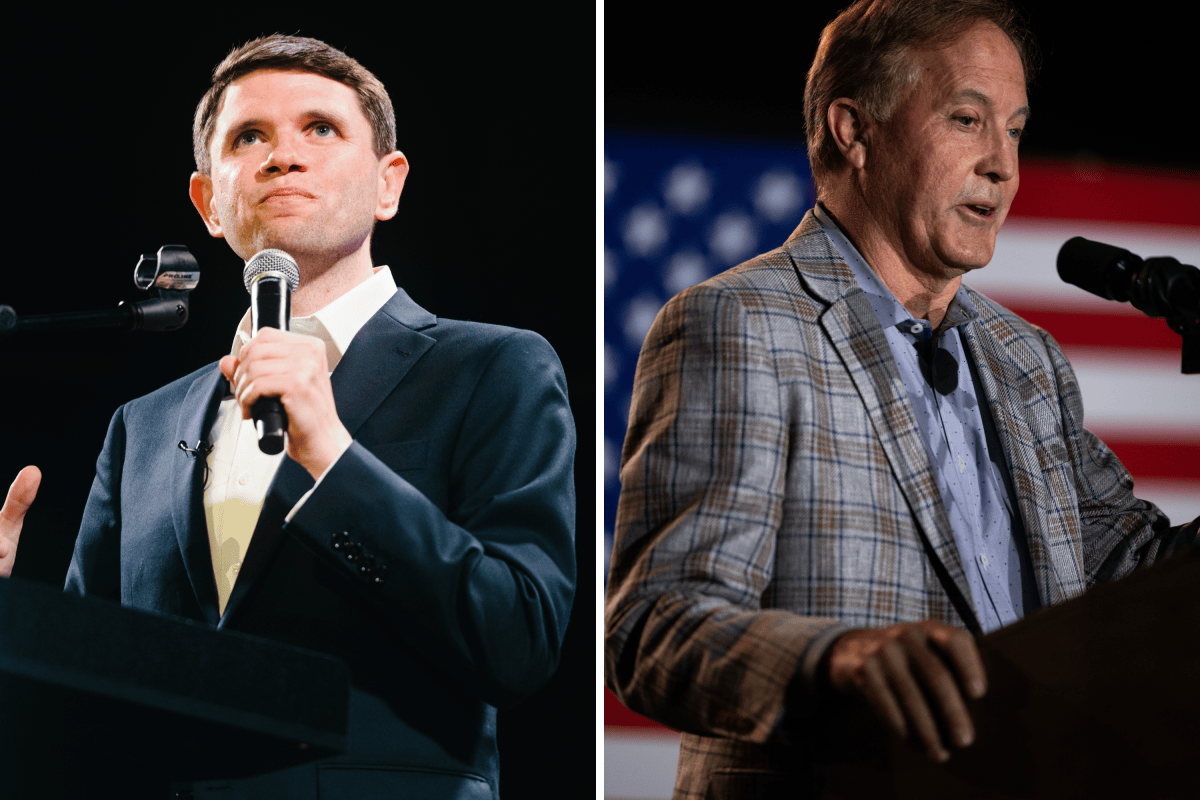
Ad spending in this year's costliest midterm Senate races has climbed to nearly $2.8 billion, according to new figures from the media analytics firm AdImpact that were shared with Newsweek. This includes $501 million on the Texas contest between Democratic state Representative James Talarico and Texas Attorney General Ken Paxton, a Republican—making it only the second nonpresidential race to cross the half-billion threshold and one of the most expensive contests in history. The figures show that both parties—but particularly the GOP—are spending heavily in states that could be considered in play.
This comes amid wider signs that Republicans, who currently hold narrow majorities in both chambers, are preparing for a difficult Election Day. Voter dissatisfaction with the administration and its policies remains high, and longtime GOP strategists have said that President Donald Trump already appears to be preparing excuses in the event of a blue wave. The estimates provided on Tuesday show that Republicans have spent a total of $1.6 billion on this year's Senate races, nearly half a billion dollars more than the $1.1 billion from Democrats and $136 million from independents.
Texas is the overall leader at $501 million, with $367 million in pro-Republican spending, $133 million supporting the Democrat and $1.2 million from independents. The Lone Star State is followed by Ohio ($452 million), Michigan ($297 million), Maine ($259 million) and Iowa ($207 million). In each of these races, Republicans have significantly outspent their rivals, something experts have chalked up to the party's determination to protect its Senate majority and the Texas seat in particular, as well as insecurity about certain races and candidates.
"Political professionals from both parties understand that losing Texas would be a crippling blow to the Republican Party nationally," Cal Jillson, a political-science professor at Texas' Southern Methodist University, previously told Newsweek. "Republican Texas leads the attack on Democrat administrations in Washington, anchors the party in Congress, and is absolutely indispensable to carrying the Electoral College in presidential elections." "Competitive races drive up the price tag of elections," said Brandon Rottinghaus, a professor in the University of Houston's Department of Political Science. "Texas is large and competitive, so the sticker shock is real." Rottinghaus told Newsweek that spending in Texas "will move the needle, but only a little," adding that the race "is largely baked at this point." On a per-voter basis, Maine and Alaska—two particularly competitive contests—have seen the most invested in ads either supporting a candidate or detracting from their opponent's campaign.
In Maine, where Republican incumbent Susan Collins is seeking a sixth term and fending off a challenge from Democratic former state Senator Troy Jackson, enough has been spent to offer each voting-age Mainer $221.55. This includes the equivalent of about $128 in Republican ad spending per voter and $93 by the Democrats. Alaska is a close second, with $207.45 being spent per voting-age resident, based on $117 million in overall spending and an adult population of about 566,000.
Analysts and insiders are split on the potential impact of ad spending, even on the scale demonstrated by this year's Senate races, suggesting that this may hinge on the number of undecideds and reluctant voters three weeks out. In the case of Maine, 10 percent of respondents in a CBS News/YouGov survey conducted September 23 to October 1 said they could still change their minds ahead of Election Day. Phil Harriman, a political commentator and former Maine Republican state senator, told Newsweek earlier this week that the "competitive" nature of the race could explain the high levels of spending, as well as the fact that "the Maine media market is a relatively lower cost market to get on the airwaves." However, he said that with only weeks until the contest is over, "the advertising barrage is numbing, voters are ignoring the ads, [and] very few people have not decided whom they are going to vote for." In the Texas Senate race, Republican political consultant Brendan Steinhauser told Newsweek last week, ad spending has "diminishing returns." However, he said that this could increase turnout "at the margins," something he believes Republicans "really need." "It's baked in.
Extract — continue reading at the source.