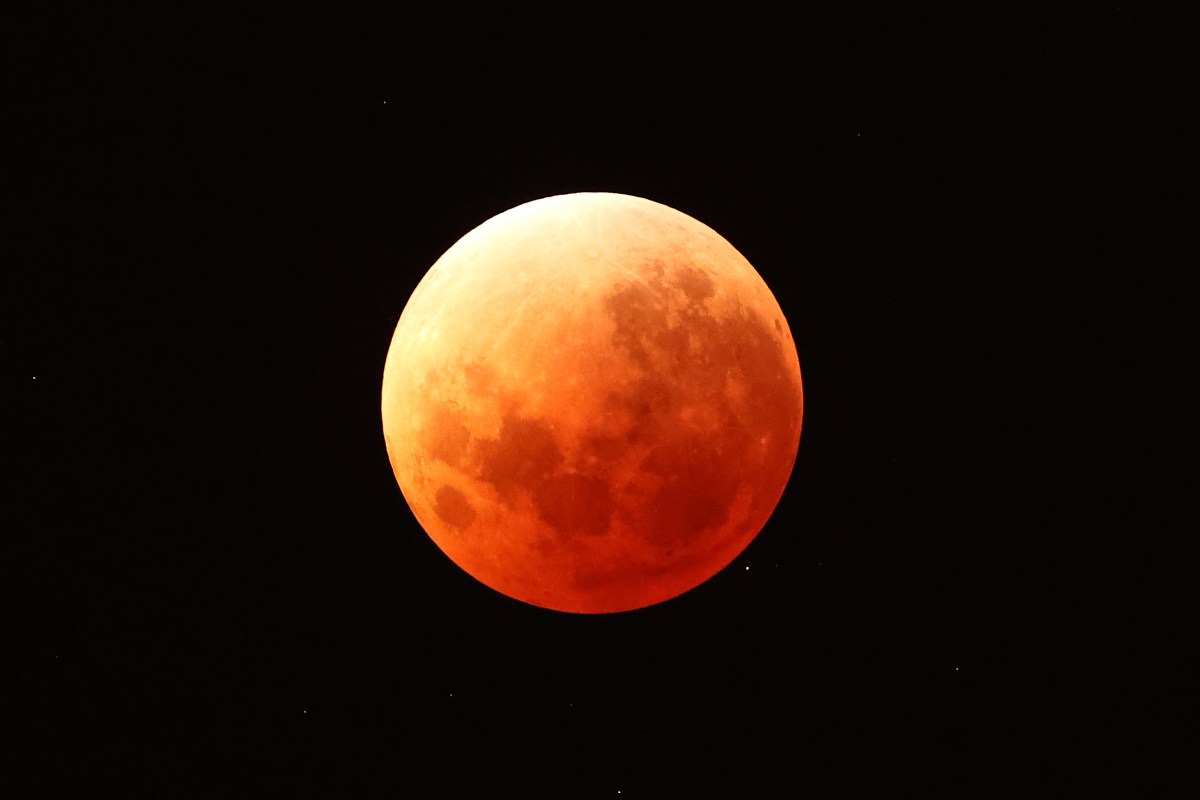
A deep partial lunar eclipse will be visible across much of the United States late Thursday into early Friday, but not every state will get the same view. Weather forecasts suggest portions of the Midwest and West Coast could have some of the clearest skies for watching the event, when about 96 percent of the moon will be covered by Earth's shadow. For millions of Americans, the eclipse offers a rare chance to witness one of the sky's most striking natural spectacles without special equipment or travel.
"It looks like there's going to be a front that's moving through the eastern United States, and there's going to be widespread showers and thunderstorms basically from New England southward through the Mid-Atlantic and into the Southeast," AccuWeather senior meteorologist John Feerick told Newsweek. "So pretty much anywhere along I-95 and then farther south into the Deep South like Louisiana, Alabama, Mississippi, and Georgia, it's probably going to be pretty difficult viewing for the eclipse." A deep partial lunar eclipse is set to take place overnight on August 27 into August 28, when Earth passes between the sun and the full moon, casting its shadow across roughly 96 percent of the lunar surface. At the moment of greatest eclipse, around 12:12 a.m.
EDT on August 28, only a thin sliver of the moon will remain in direct sunlight, while the rest may take on a reddish or copper-colored hue often associated with so-called "blood moons." The eclipse will be visible across North and South America, as well as parts of Europe and Africa, weather permitting. Unlike a solar eclipse, no special eye protection is needed to watch the event. Observers across the United States can follow the eclipse from late evening on August 27 through the early hours of August 28, with peak viewing around midnight Eastern time.
Astronomers note that this will be one of the most dramatic lunar eclipses visible until late 2028 because such a large portion of the moon will pass through Earth's darkest shadow, known as the umbra. The deep partial lunar eclipse begins on the evening of August 27, when the moon first enters Earth's faint outer shadow, the penumbra, at 9:23 p.m. The more noticeable partial phase starts at 10:33 p.m.
EDT, as Earth's darker central shadow, known as the umbra, begins moving across the lunar surface. For most skywatchers in the United States, the best viewing time will be around 12:12 a.m. EDT on August 28, when the eclipse reaches its maximum, AccuWeather reported.
At that point, about 96 percent of the moon will be immersed in Earth's umbral shadow, creating what astronomers describe as an "almost blood moon" appearance, space.com reported, with much of the lunar disk potentially glowing reddish-orange. The partial phase continues until 1:52 a.m. Weather could play as big a role as geography in determining who gets the best view of this week's deep partial lunar eclipse.
Extract — continue reading at the source.