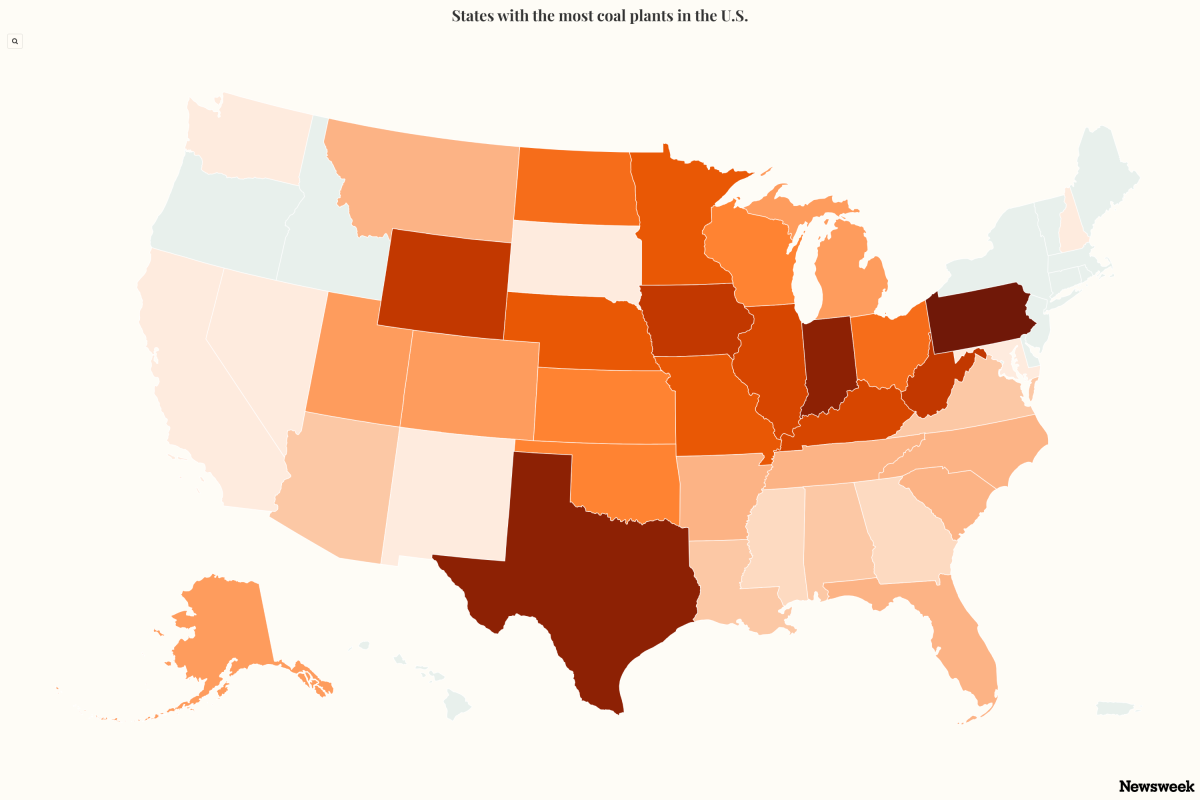
A map created by Newsweek shows the states boasting the most coal plants as the Environmental Protection Agency (EPA) could repeal a major Biden-era climate rule that limits greenhouse gas emissions from coal and natural gas power plants as soon as Monday. The rule change was proposed last year and comes as the United Nations has repeatedly warned of worsening climate change because of global warming. Meanwhile, President Donald Trump has expressed support for coal and other fossil fuel industries and Administrator Lee Zeldin has said the change could eliminate significant costs across the industry as well as “unleash” American energy.
If finalized, the change would not be the first major shift to occur this year. In February, the repealed its 2009 Greenhouse Gas Endangerment Finding, meaning that engine and vehicle manufacturers no longer were required to measure, control, or report greenhouse gas emissions for vehicles. Newsweek reached out to the by email on Monday for comment.
Domestic coal use has declined over the past 20 years due to shifts toward renewable energy, but the United States remains among the world’s top coal producers. According to data from Cleanview, a platform that tracks U.S. energy infrastructure, there are more than 200 coal-powered plants in the country. At 13 facilities, Pennsylvania leads the country with the most coal plants followed by Indiana and Texas with 12 each.
Several states have no reported facilities, such as Idaho, Oregon, Hawaii, New York, New Jersey, Delaware, Connecticut, Rhode Island, Massachusetts, Vermont, and Maine, according to the data. Should the greenhouse gas emissions limit change be finalized, the states with the greatest concentration of coal plants could see the most drastic health impacts, Center for Climate and Energy Solutions President Nathaniel Keohane told Newsweek, particularly in Appalachia and the Ohio Valley. However, the impacts on global warming would be much more widespread and affect everyone, he added.
Despite concerns from some energy experts, the American Coal Council has praised the EPA's proposal. "The EPA's proposal is an important step toward preserving a reliable, affordable, and secure electric grid," American Coal Council CEO Emily Arthun told Newsweek. "Coal remains one of the nation's most dependable sources of baseload power, providing the around-the-clock electricity that supports American households, businesses, manufacturers, hospitals, and critical infrastructure." While the possible change could reduce the cost of producing electricity, it comes with a cost of its own, Bryan Hubbell, a senior fellow at Resources for the Future and the former national program director for the Air, Climate, and Energy Research Program at EPA's Office of Research and Development, told Newsweek.
"[T]he rollbacks are expected to worsen air quality, which could be responsible for tens of thousands of premature deaths, hospital and emergency department visits, and millions of asthma exacerbations," he said. "The bottom line is that the reduced costs of producing electricity may save money over the coming decades, but the increased climate and air quality damages will cost society much, much more. This rollback is a bad deal for the American people and the world." The proposal has sparked pushback from energy industry experts, who cited health issues and global warming among their greatest concerns.
Extract — continue reading at the source.