The midterm elections take place on Tuesday, and voters are finalizing their plans on when they will cast their vote before the polls close. The election will determine which party controls Congress as Republicans seek to defend their House and Senate majorities and Democrats look to capitalize on competitive races that could flip control of both chambers to their favor. Early voting has already taken place, and many states have seen strong turnout, including Texas, where early voting began with a record 19 million registered voters eligible to cast ballots.
Millions of Americans nationwide have yet to cast their ballot, and voters hoping to vote in-person on Election Day should be aware that poll schedules vary depending on the state. Poll lines can be long, but as long as voters are in line before the polls close, they will be allowed to vote. Polling place schedules vary depending on the state, with most opening in the early morning and closing at either 7 p.m. or 8 p.m.
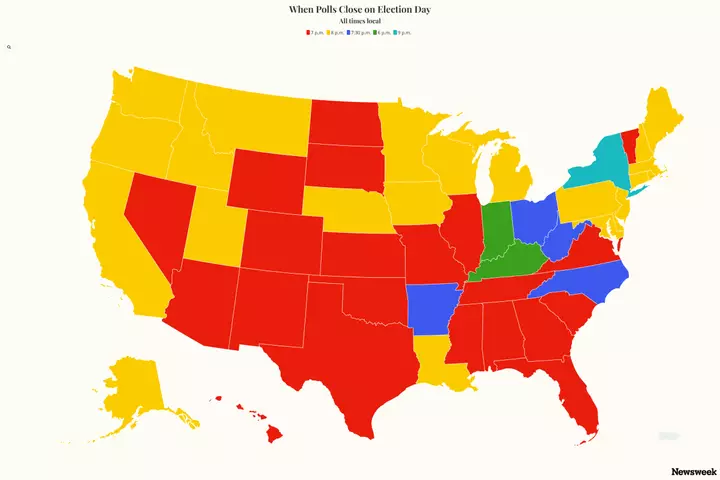
The closing time for polls in each state is listed below in local time. A map created by Newsweek also shows the time polls close. Voting results will begin to trickle in as early as 7 p.m. or 8 p.m.
However, since polls don't close until as late as 11 p.m. Eastern time for Western states, nationwide results likely won't be available until very late. Eastern time, many key Senate race results will have taken shape, though some contests might still be too close to call.
Major news organizations often project winners before all ballots are counted when the remaining vote is unlikely to change the outcome, but some races may not be called on election night and control of Congress could still be unresolved. The state with polls open the latest local time is New York, where polls close at 9 p.m. Polls close the earliest in Indiana and Kentucky at 6 p.m.
There are several key Senate races unfolding this year that will determine control of Congress. Republicans are trying to fight off a blue wave to defend their narrow majority. Democrats need a net gain of four seats to win control of the Senate and a net gain of three seats to win control of the House.
Extract — continue reading at the source.