The human substantia nigra (SN) is a central hub for dopaminergic signalling and a key site of pathology in Parkinson’s disease (PD). However, its internal functional organization in human individuals is not well understood. To fill this knowledge gap, here we applied connectopic mapping to the SN in more than 1000 participants from four independent datasets.
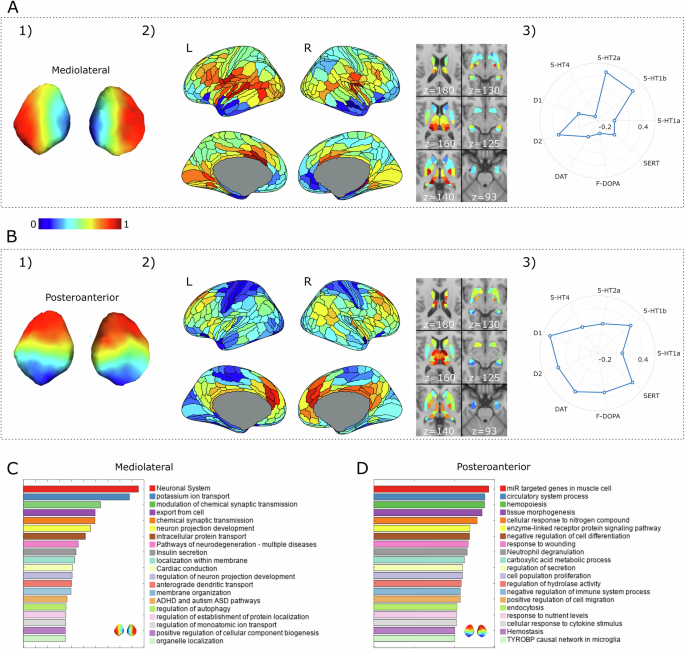
We identified two main gradients or axes of functional organization within the SN—a mediolateral and a posteroanterior—each showing distinct transcriptomic, behavioural, and pathological associations. Specifically, the mediolateral gradient was related to motor and executive functions, aging and α-synuclein pathology in both PD and Alzheimer’s disease (AD). In contrast, the posteroanterior gradient was linked to memory, anxiety, depression and other neuropsychiatric symptoms in all cohorts.
We found gradient-specific associations with gene expression profiles, neurotransmitter maps and cerebrospinal fluid biomarkers that further supported their neurobiological differences. Together, these results reveal a dual-gradient architecture that reflects the functional heterogeneity of the SN and offers new markers, grounded in behaviour and pathology, for stratifying neurodegenerative disease risk in aging, PD and AD. The substantia nigra (SN) is a key midbrain nucleus and the brain’s main source of dopamine [1], long recognized for its involvement in motor control [2] and in the pathogenesis of Parkinson’s disease (PD) [3].
Classically, the SN is divided into the pars compacta (SNc) and pars reticulata (SNr), associated with dopaminergic and GABAergic outputs, respectively [4]. However, although this anatomical distinction has guided decades of research, it does not fully reflect the complex organization of the SN or the breadth of its functions. At a finer scale, the SNc comprises multiple dopaminergic cell subtypes—ventral, dorsal, and densocellular—arranged along a dorsomedial–ventrolateral axis [4, 5].
These neuronal populations form a diverse set of projections, connecting not only to the adjacent SNr [6] but also to widespread cortical and subcortical regions. Through these pathways, the SN contributes to processes that extend well beyond movement, including motivation, reward learning, salience, and decision-making [7,8,9]. This diversity of roles raises the need for approaches that can capture the SN’s full functional complexity.
Yet few studies have examined its whole-brain functional architecture in a way that moves past discrete subdivisions [10], particularly in relation to the combination of motor, cognitive, and psychiatric changes frequently observed across neurodegenerative conditions, including those not traditionally associated with the SN, such as Alzheimer’s disease (AD) (11). In AD, structural alterations and dopaminergic dysfunction within the SN have been linked to memory impairment and cognitive decline (12, 13), consistent with the SN’s broad connectivity and its role in cognitive and motivational processes. Recent advances in neuroimaging now allow the SN to be studied with unprecedented detail.
Extract — continue reading at the source.