Psychosis exhibits marked neurobiological heterogeneity that is not adequately captured by symptom-based diagnoses. Although prior efforts have identified subgroups, it remains unclear how latent disease variability manifests within the brain’s multiscale intrinsic functional organization and whether these patterns can be leveraged to systematically identify biologically driven subtypes of psychosis. Here, we aim to identify Psychosis Imaging Neurosubtypes (PINs)—homogeneous subgroups defined solely from neurobiological features of brain function, independent of clinical or cognitive definitions, and whether these subgroups show meaningful phenotypic differentiation.
Resting-state fMRI data from 2103 B-SNIP 1&2 participants were used to compute subject-specific multiscale functional network connectivity (msFNC). We then derived a low-dimensional neurobiological subspace, termed Latent Network Connectivity, which captured system-wide interconnected multiscale information across three components. Projections of probands msFNC onto this subspace revealed three PINs through unsupervised learning that spanned DSM diagnoses (Schizophrenia, Bipolar, Schizoaffective Disorder).
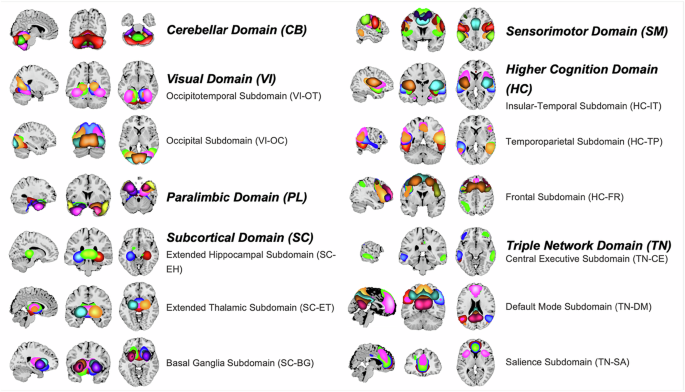
Although defined purely from intrinsic neurobiology, PINs exhibited distinct cognitive, clinical, and connectivity profiles. PIN-1, the most cognitively impaired, showed Cerebellar-Subcortical and Visual-Sensorimotor hypoconnectivity, alongside Visual-Subcortical hyperconnectivity. Most cognitively preserved PIN-2 showed Visual-Subcortical, Subcortical-Sensorimotor, and Subcortical-Higher Cognition hypoconnectivity.
PIN-3 exhibited intermediate cognition, showing Cerebellar-Subcortical hypoconnectivity alongside Cerebellar-Sensorimotor and Subcortical-Sensorimotor hyperconnectivity. Although covariate-adjusted analyses did not reveal significant clinical differences among PINs, exploratory analyses identified selective differences in YMDR, PANSS, and Age of Onset. Notably, 55% of relatives aligned with the same neurosubtype as their probands, a rate significantly higher than chance and than DSM-based alignment, suggesting potential heritability.
Cognitive performance reliably aligns with distinct brain connectivity patterns, which are also evident in relatives, supporting their construct validity. Our PINs partially converged with previously reported BSNIP Biotypes with some correspondence (e.g. PIN1 with Biotype 1) but not with the other Biotypes, which were determined using integrated electrophysiological, cognitive, and oculomotor data, supporting convergent validity, while also indicating that intrinsic rsfMRI derived multiscale connectivity partitions psychosis heterogeneity somewhat differently from multimodal biomarker approaches.
These findings underscore the limitations of DSM-based classifications in capturing the biological complexity of psychotic disorders and highlight the potential of imaging-based neurosubtypes to enhance our understanding of the psychosis spectrum. Psychosis reflects alterations in brain structure and function, affecting perception, thought and behavior with variable consequences for social and occupational functioning [1]. Disorders like Schizophrenia, Psychotic Bipolar Disorder, and Schizoaffective Disorder are complex and biologically heterogeneous, with overlapping symptoms and cognitive dysfunction [2, 3].
Extract — continue reading at the source.