Film Festival (VIFF) As a filmmaker, Markus Schleinzer owes much to his 17-year career as a casting director. Both require making the right choices under pressure and persuading others to believe in them. For a casting director, that means convincing a filmmaker or producer.
For a director, it means earning the audience’s trust. Schleinzer admits that, despite what people might think, he can be rather shy and timid. Casting offered a way to remain somewhat in the background while still being deeply involved in the filmmaking process.
For years, he worked closely for Michael Haneke as his casting director. But Haneke also gave Schleinzer opportunities to direct background performers and learn how a film set operates. Haneke was also the one who urged him to step out from behind the scenes and become a filmmaker himself, giving him three months to write a script.
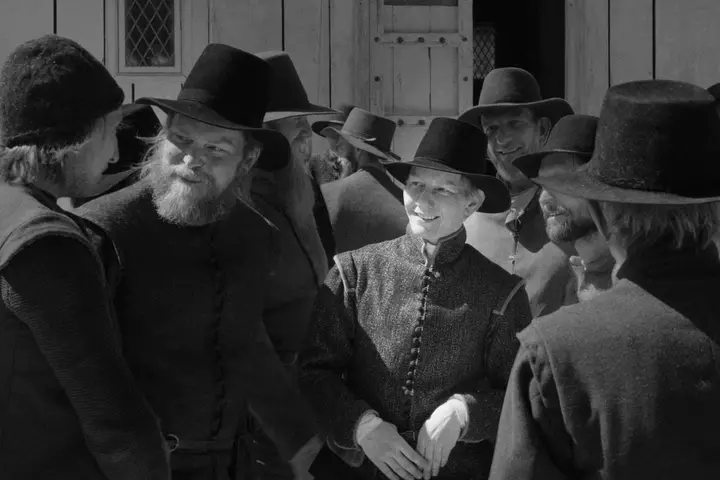
Haneke liked it and refused to let it languish in a drawer, passing it along to French producer Margaret Ménégoz, who called Schleinzer to say she wanted to make it.“So I was trapped,” he says. This is how I, finally, got kicked in my ass.” His third feature, “Rose,” which screened at the Vancouver International Film Festival (VIFF), is a black-and-white historical drama starring Sandra Hüller as a woman who disguises herself as a male soldier in 17th-century Germany. By exposing the contradictions of a society that values people for what they can contribute while restricting who is allowed to contribute, the film turns one woman’s struggle to live freely into a broader indictment of the rules governing gender and belonging.
Schleinzer wrote the role specifically for Hüller, whose performance continues to move him even after countless viewings. Still, there were moments, there were sentences, there were scenes, where she completely moves me, where I start to cry, where I get angry again, like an audience member who sees this for the very first time. And that’s the craft she’s owning.
That’s her superpower she’s owning.” The film began as a sprawling prose work of roughly 1,000 pages, tracing Rose’s life from early childhood. Of course, Schleinzer understood that no one was going to spend millions making a 45-hour film. That’s a poem.” If there is a through line in Schleinzer’s work, it is his fascination with people on the margins.“Where we are as a society, how we deal with our so-called outsiders, what kind of society we are is quite interesting for me,” he says.
Extract — continue reading at the source.