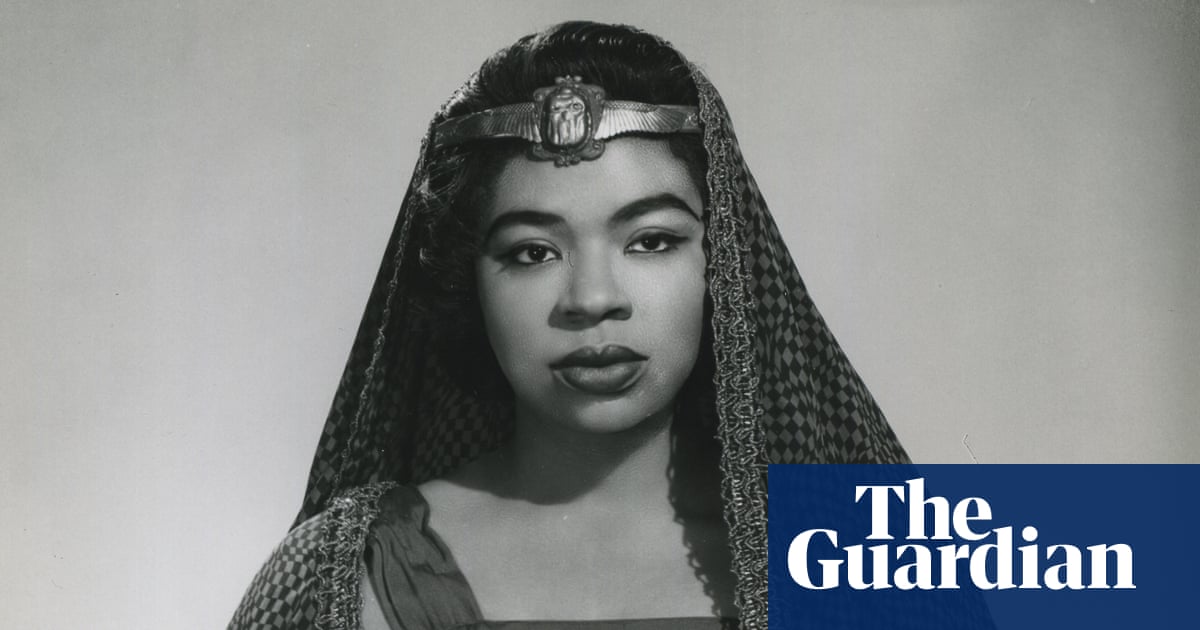
The soprano Martina Arroyo, who has died aged 90, was one of the generation of black American opera singers – others were Marian Anderson, Leontyne Price, Shirley Verrett and Grace Bumbry – who in their early careers faced institutionalised racial prejudice before achieving international recognition. Having proved herself to be one of the finest exponents of the leading Verdi roles, Arroyo was finally able to establish herself in the US, as well as worldwide, and went on to become, after her retirement from the stage, a distinguished teacher and ambassador for the art form. Although her vocal talent had been noticed at an early age, she was advised, in view of the paucity of opportunities for black singers, to develop a back-up career – she was engaged for a year as a high-school classroom teacher and for two further years as a social worker – before achieving a measure of recognition from two events in 1958, when she was 22.
In March that year she won the Metropolitan Opera Auditions of the Air, an annual singing competition sponsored by the Met, performing Aida’s O Patria Mia, and in September she made her debut at Carnegie Hall as the First Coryphée in the American premiere of Ildebrando Pizzetti’s Assassinio nella Cattedrale (based on TS Eliot’s Murder in the Cathedral). She made her official Met debut the following year in the small role of the Celestial Voice in Don Carlo, but then for three seasons sang only supporting roles. Advised to make her career in Europe, where skin colour was a less prohibitive issue, she was given prominent roles at major houses including Vienna, Deutsche Oper Berlin, Hamburg, Frankfurt and Stuttgart.
This was a period of intense activity, requiring her in one year to perform in 45 different European cities over a span of 48 days. She also had a residency at this time with Zurich Opera (1963-65) and it was while visiting her family in New York in 1965 that she received a telephone call from Rudolf Bing, general manager of the Met, inviting her to cover for Birgit Nilsson as Aida in two days’ time. Assuming it was a practical joke, Arroyo replied that she usually went to a matinee film that day with her mother, but thought she could make it to the opera in time for the evening performance.
Bing assured her it was no hoax and went on, in view of the standing ovation she received that night, to offer her a contract, as a result of which she won acclaim in Don Carlo, Madama Butterfly and Il Trovatore. She was still not offered new productions there, but did open three seasons in Verdi roles, which were to become her staples. In these roles, notably Leonora in both Il Trovatore and La Forza del Destino, Amelia in Un Ballo in Maschera, Lady Macbeth, Elvira in Ernani and Elisabetta di Valois in Don Carlo, but also in the title roles of Madama Butterfly and Ponchielli’s La Gioconda, she displayed an alluringly voluptuous voice, yet with a steely core.
She also had an ability to soar at climaxes but to fine down the tone in more intimate passages. One critic spoke for many when he described Arroyo’s as “the most dramatic and genuine Verdian voice to be heard these days” in 1970, though she was occasionally criticised in later years for a less developed ability to inhabit roles. Born in Harlem, New York, to Demetrio Arroyo, a mechanical engineer, and Lucille Washington, an amateur pianist, Martina was taught the piano by her mother, sang in local choirs and was encouraged in her enthusiasm to learn ballet.
After attending Hunter College high school, affiliated with the prestigious Hunter College, she was in due course admitted to the latter, deciding to read Romance languages, the better to advance a career in opera. She had already been taking lessons, from the age of 14, from the voice coach Marinka Gurewich, teacher of Bumbry, among many others, and stayed with her for the next 40 years, until her own retirement and Gurewich’s death. She made her UK debut in 1968 as Valentine in a concert performance of Meyerbeer’s Les Huguenots at the Royal Albert Hall, alongside Joan Sutherland and Gabriel Bacquier, conducted by Richard Bonynge.
Extract — continue reading at the source.