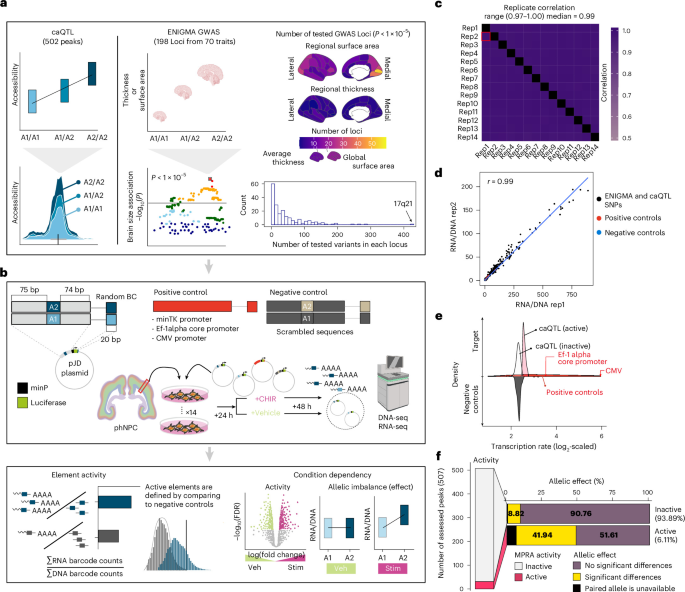
Genetic association studies have identified hundreds of largely noncoding loci associated with interindividual differences in the structure of the human cortex, although the specific functional variants contributing to these phenotypes are unknown. Here we implemented a massively parallel reporter assay to measure the regulatory activity of 9,092 cortical-structure-associated variants in human neural progenitor cells at baseline and during Wnt stimulation. We identified 918 variants with regulatory potential from 150 cortical-structure-associated loci (76% of loci studied), of which more than 50% showed allelic effects.
Wnt stimulation modified regulatory activity at a subset of loci, revealing condition-dependent enhancers. Massively parallel reporter assay activity was largely induced by Alu elements, suggesting that they contribute to cortical expansion. The region-specific impact of motif-disrupting variants is probably mediated by spatially localized transcription factor expression during development.
Together, these results provide a genome-scale functional framework for understanding how noncoding variation influences cortical structure. The expansion of the cerebral cortex in humans, relative to nonhuman primates, is thought to contribute to our distinctive cognitive and social abilities1,2. Genetic association studies conducted in large consortia, including the Enhancing Neuroimaging Genetics through Meta-analysis (ENIGMA), have identified single-nucleotide polymorphisms (SNPs) associated with interindividual variability in human cortical surface area (SA) and thickness (TH) measured with magnetic resonance imaging, providing a foothold into the molecular mechanisms affecting human cortical size and shape3.
However, most cortical-structure-associated variants are found in noncoding regions of the genome without a clearly defined function. Cortical-structure associations are enriched in regulatory regions of the genome active in primary human neural progenitor cells (phNPCs) and colocalize with genetic variants influencing chromatin accessibility—a proxy for transcription factor (TF) binding—and gene expression specifically in NPCs (chromatin accessibility/expression quantitative trait loci (ca/eQTLs))3,4,5,6. This suggests that cortical-structure-associated variants alter gene regulatory elements by modifying TF binding and gene expression, impacting fate decisions of NPCs during prenatal development, ultimately leading to differences in cortical size in adulthood.
TFs exhibit regionally specific expression patterns7 and translocate to the nucleus in response to activation of developmental signaling pathways such as Wnt8, which may lead to variants having stronger or weaker effects within specific regions or in stimulated conditions. This hypothesis is supported by cortical structure associations enriched within Wnt responsive regulatory elements and associations found near genes involved in the canonical Wnt pathway3,6. Gene regulatory elements are marked by accessible chromatin or histone posttranslational modifications that allow TF binding; through looping with promoters, they can influence gene expression9,10,11,12.
In addition to chromatin loops, enhancer RNAs (eRNAs), transcribed in noncoding genomic regions, initiate looping through complementarity to promoter upstream antisense RNAs (uaRNAs), recruiting polymerase to increase transcription13,14. The latter mechanism involves co-opting the expression of Alu elements, a set of transposable elements that are prevalent across the human genome15. Alu elements have been theorized to strongly contribute to human cortical evolution because they have increased in prevalence together with brain size along the human lineage16.
Extract — continue reading at the source.


