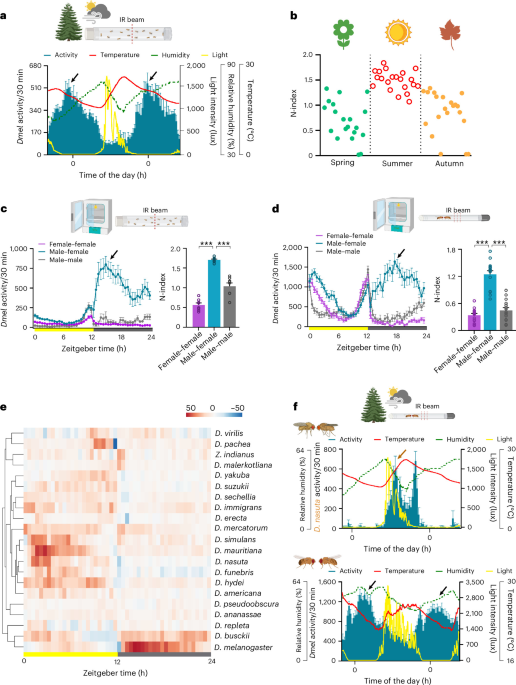
Animals confine their daily activity to distinct diurnal, crepuscular or nocturnal windows. It remains unclear how hundreds of sympatric species sharing the same temporal niche manage to coexist. To address this, we monitored the daily activity of the twilight-active, species-rich Drosophila genus under naturalistic conditions.
Here we show that intense sociosexual interactions rapidly drive a species-specific reformatting of their canonical crepuscular niche. The dominant sensory modality used for sexual communication predicts niche-shift direction: reliance on chemosensation for courtship redirects behavioural activity into the night, while visual reliance shifts it into the day. This temporal plasticity bypasses the circadian clock, instead operating via a conserved dopaminergic pathway that simultaneously inhibits sleep and sustains sexual motivation.
Our results reveal how mating imperatives enable conditional colonization of otherwise restricted temporal windows. Ultimately, by driving the divergence of previously overlapping niches, sociosexually induced temporal plasticity provides a powerful mechanism for sympatric coexistence in crowded environments. This is a preview of subscription content, access via your institution Access Nature and 54 other Nature Portfolio journals Get Nature+, our best-value online-access subscription Receive 12 digital issues and online access to articles Prices may be subject to local taxes which are calculated during checkout Numerical source data underlying the main and Extended Data figures are available via figshare at https://doi.org/10.6084/m9.figshare.33111071 (ref. 88).
Owing to their large file sizes, raw behavioural activity log files and microscopy images were not deposited in the public repository but are available from the corresponding author upon reasonable request. Source data are provided with this paper. Custom codes used for data analysis and statistical processing are included in the Source Data package provided with this paper and are available via figshare at https://doi.org/10.6084/m9.figshare.33111071 (ref. 88).
Kronfeld-Schor, N. & Dayan, T. Partitioning of time as an ecological resource. Syst. 34, 153–181 (2003).
E., Yoshikawa, T., Hillson, H. & Menaker, M. Retinal pathways influence temporal niche. USA 105, 13133–13138 (2008).
Extract — continue reading at the source.


