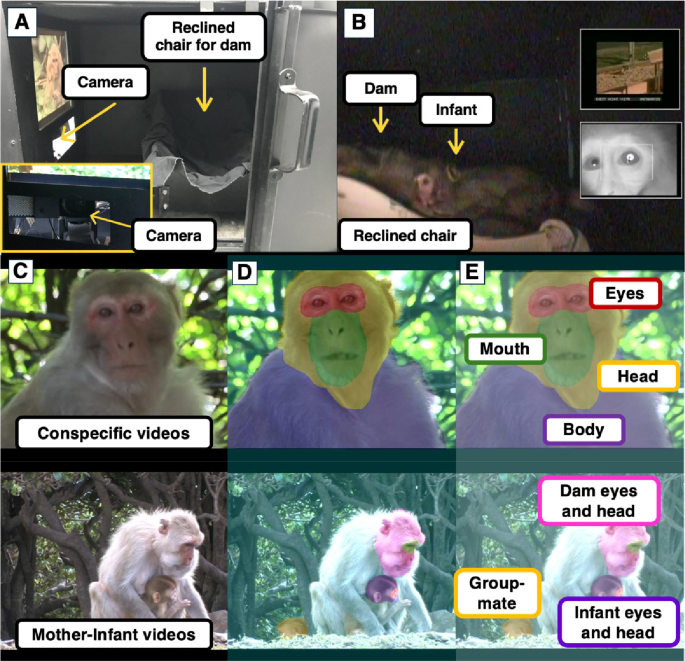
Visual attention to others in our immediate environments serves as an adaptive mechanism for early learning across primate species. This study leverages longitudinal eye-tracking data from male infant rhesus macaques collected at up to 14 timepoints from birth to six months to chart visual attention patterns to social videos of unknown conspecifics or mother-infant dyads in a group setting. The distribution of oculomotor movements that index the extent of infant attention to the video stimuli – fixations, saccades, and inattention, i.e., data lost to offscreen looks or movement – stayed constant during this developmental period.
Attention to different body areas – mouth, head and body - showed subtle and progressive changes from birth to six months, except for attention to the eyes of conspecifics, which showed two distinct periods of significant increase. The matrilineal social rank of the infant was also investigated as a social factor related to patterns of attention. Rank was significantly associated with the percent of time infants spent making saccades, such that low-ranking infants spent more viewing time making saccades than their high-ranking peers.
This association was established by five weeks of age. Collectively, these results provide insight into processes of social attention related to social status in rhesus macaques during infancy. Visual attention to social information is a key mechanism by which we navigate the complex sensory environments of everyday life.
Our preference for social information, particularly the eyes of other people over other features of the face and body, emerges in early infancy and is an adaptive behavior for social learning associated with the acquisition of social communication and perception skills1,2,3. Attention to caregivers’ facial expressions, eye contact, and vocalizations facilitate the developing infant’s attentional preferences for visual cues from the eye region and face of conspecifics (reviewed in4. Cross-species studies of humans, great apes, and other non-human primates (NHPs) demonstrate that patterns of social attention, particularly to the eyes of others in the respective species, are evolutionarily conserved, both in terms of perceptual strategies and developmental changes5,6.
This convergence indicates that patterns of social visual attention may reflect an adaptive mechanism for early learning across primate communities defined by complex social environments and interactions. Rhesus macaques are an indispensable model system for human social development due to their altricial birth, dynamic social learning environment, and accelerated developmental timeline of approximately 1:4, e.g. one week in macaque development equating to four weeks in human development (reviewed in7). In addition, they allow for densely sampled behavioral and neuroimaging data challenging to obtain in human infants and minimization of confounding factors that are difficult to control in human studies (e.g., diet, education, and exposure to prenatal stress).
Reported cross-species convergences between rhesus macaques and humans in brain and behavior development during infancy7,8,9,10,11, have established a strong foundation for continued investigation into the maturation and refinement of visual attention patterns and their neural correlates in rhesus macaque infants. The first two postnatal months (eight weeks) are a period of key transition in social attention preferences in infant rhesus macaques. By four weeks of age, infant macaques reliably prefer face-like schematic configurations over other patterns12, and around 6–8 weeks, they exhibit a preference switch from initially attending to direct gaze13 and conspecific faces (other macaques) to attending more to averted gaze and heterospecific (other primate) faces14.
Extract — continue reading at the source.


