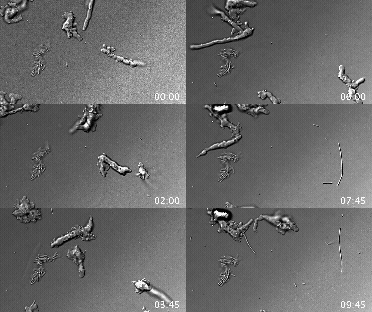
Northern California’s Lassen Volcanic National Park features wildflower meadows, mountain lakes and volcanoes—and, according to new research, a record-breaking organism. Its hot springs are home to a newly identified single-celled organism that’s redefining the heat limits of complex life. An amoeba named Incendiamoeba cascadensis—which means “fire amoeba of the Cascades”—can survive and swim around at a sweltering 147 degrees Fahrenheit, researchers report in the journal Cell on September 22.
Discovering such endurance here on Earth broadens the map of where scientists might search for life elsewhere in the universe, too. Prokaryotes are simple, single-cell organisms that lack a nucleus and other membrane-bound organelles. They were probably Earth’s first life forms, and today, they include bacteria and archaea.
Eukaryotes, on the other hand, are more complex organisms with cellular organelles, such as mitochondria to provide energy and a nucleus to store genetic material. This class includes a wide range of beings, including humans, plants and single-celled algae. Some prokaryotes are known to survive in extreme environments and are aptly called extremophiles.
The archaeon Methanopyrus kandleri, for example, can endure temperatures up to 252 degrees—and is the reigning champ for heat tolerance among all life. Less research has been conducted on heat-loving eukaryotes. That’s partly because their biomolecules and membranes usually break down in scorching conditions.
In fact, researchers had previously suggested that eukaryotes’ organelle membranes couldn’t remain stable above 144 degrees—but the new research shows that at least one species is tougher than they thought. In the new study, Rappaport and colleagues used long barbecue tongs to dunk vials into steaming water from geothermal springs at Lassen Volcanic National Park, Ari Daniel reports for NPR. They brought the samples to the lab and saw that the water contained amoebas.
So, the team grew the organisms and subjected them to all sorts of tests. I. cascadensis was doing just fine, so the team cranked up the heat. At 145 degrees, the amoeba still replicated.
Extract — continue reading at the source.