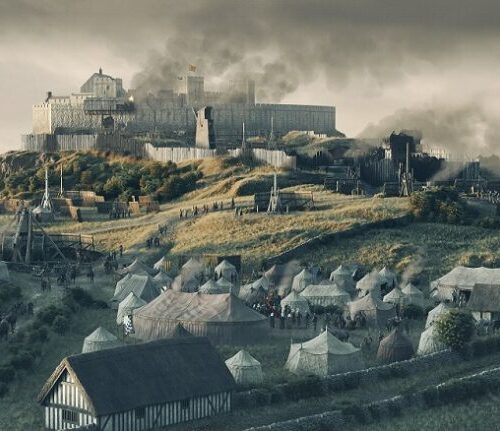
During a medieval siege, a trebuchet scored a chance hit one unlucky defender. A small boulder slammed into his upper back at close to 300 kilometers an hour, smashing bones and crushing him beneath its weight. The man’s skeleton lay beneath the chapel of Scotland’s Stirling Castle, along with the remains of several other people who had clearly died violent deaths.
But this one, known to us only as Skeleton 150 (or as “trebuchet guy” in your faithful correspondent’s notes), stood out even among that battle-damaged crowd because most of his upper body had been shattered. According to University of Bradford paleopathologist Jo Buckberry, who presented her research at the 25th European Meeting of the Paleopathology Association last week, skeleton 150 is the only known trebuchet casualty in history. Skeleton 150 was in terrible shape, even for a dead guy.
The man’s skull had broken in 61 separate places, and another 60 jagged bits of bone were distributed across his ribs. His right shoulder was broken, and his right leg above the knee was basically shattered. Buckberry and her colleagues threw everything they could, metaphorically speaking, at the jigsaw puzzle of broken bones: forensics, microscopes, X-rays, and micro-CT scans.
All of those results pointed to a single moment of crushing impact by something heavy and fast-moving. The pattern of the injuries suggests that the man’s right shoulder and the back of his head caught the brunt of the impact, while his ribs probably cracked under the weight of something heavy slamming him into the ground and pinning him there. The bones had broken when they were fresh, so it was clearly not a case of “oops, we dropped a big rock on the corpse.” And the amount of force required to do so much damage in a single, shattering blow ruled out several messy possible ways to die during a medieval siege: Skeleton 150 hadn’t been trampled by a horse or run over by a cart, for example.
Even if he had fallen from the castle walls, he probably wouldn’t have landed with enough force to do all of that, and the angle would have been all wrong.
Extract — continue reading at the source.