You’d be hard pressed to find a band with fewer airs and graces than Piss. First, there’s the unavoidable matter of their name, which they style in all caps, no nonsense; a word that scans as vulgar and combative but also somewhat facetious when displayed on their merch in loopy cursive, sometimes decorated with bows. The Vancouver quartet’s music is a merciless cyclone of hardcore, poetry, sound collage and performance art that revolves entirely around singer Taylor Zantingh’s experiences with sexual violence.
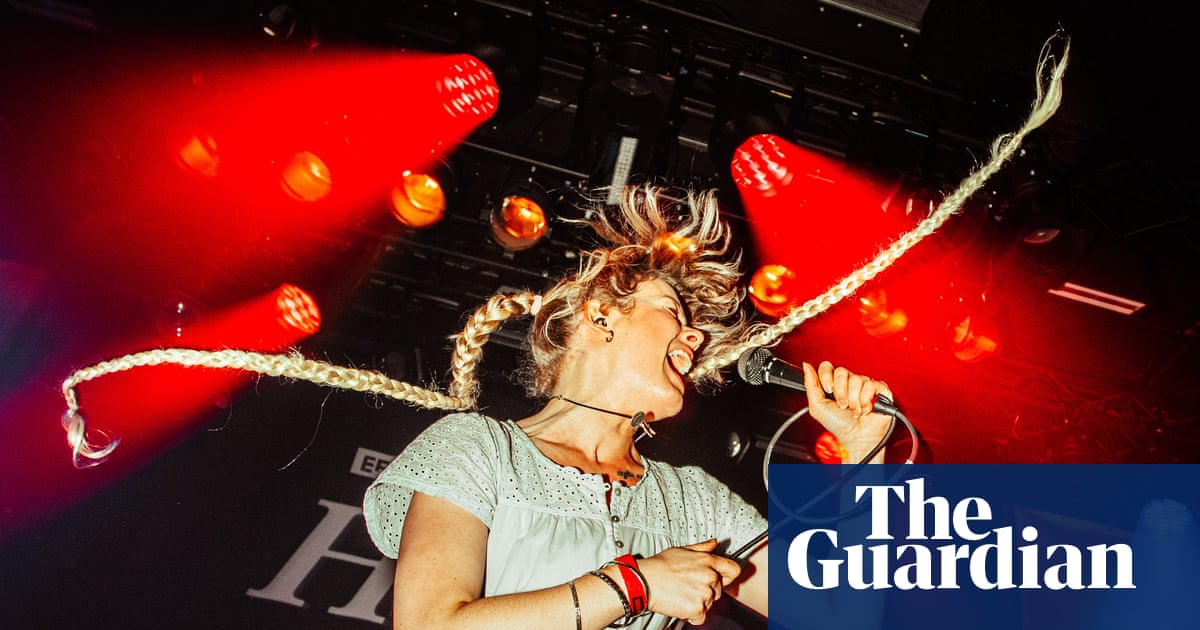
On stage at Eindhoven’s Hit the City festival in late August, the band greets the stacked crowd with a trigger warning before drummer Garreth Roberts, bassist Gavin Moya and guitarist Tyler Paterson launch into pulverising fits of noise-punk, broken up by audio samples of children laughing and feminist writer Andrea Dworkin talking about pornography. Zantingh hurls herself around, clutching at her stomach and flinging her pigtails before winding down to a nervous, twitching standstill. The intense set is finely tuned to present a narrative of gender-based violence not as entertainment, but as lived experience.
They play it exactly the same every night, and have done for the last two years. Since forming in 2024, their reputation has grown through their live performance, prompting Sub Pop to sign them; their debut album You Made Me / Skin on Linen arrives in October. Recorded over a handful of days in winter 2024, the album was made to mirror the Piss live experience as closely as possible.
Throughout, you’ll hear Zantingh gasp for breath or struggle to get words out, lacing traumatic recollections with disturbing imagery of “fingers sewn in the wrong places” and kids “practising blowjobs on glue sticks”. The songs combine Bikini Kill and Fugazi’s DIY approach to “making personal things political” with the uranium-heavy sonics of Chat Pile or Swans. Paterson, who is primarily responsible for shaping the instrumentals, likens his process to scoring a film.
Placing her voice in chorus with a range of others – activists, philosophers, militants, psychoanalysts and transgressive literary figures, including French philosopher Manon Garcia speaking about the trial of Gisèle Pelicot – leaves things open to interpretation. When I’m telling [the audience] how these events still hurt me today, and they’re watching me hurt myself in real time, they’re watching that injury in a very tangible way.” While Piss try to provide as many access points to their music as possible, it is, at every level, deeply uncomfortable. When I describe their twisted instrumentals as “gross”, drummer Garreth Roberts says, “That’s Ty’s [guitarist Tyler Paterson] favourite word!” Zantingh’s voice jolts unpredictably from soft spoken-word to chainsaw shriek.
All lyrics and samples (which they consider a reading list) are also prominently subtitled in their videos, for accessibility and so the subject matter doesn’t take a backseat to the visuals. In the queue before the gig, a number of men were sniggering about the name Piss. I wonder whether the band feel their music is always met on its own terms.
Extract — continue reading at the source.