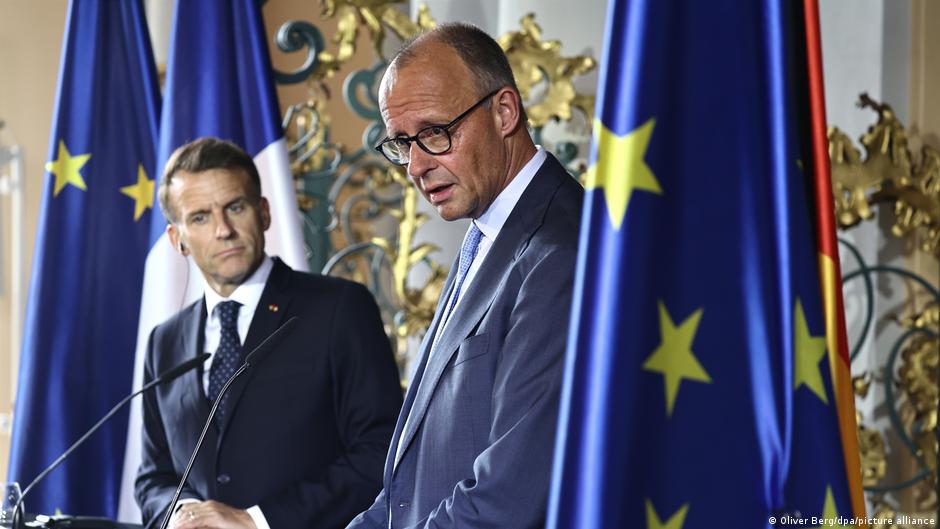
German Chancellor Friedrich Merz and French President Emmanuel Macron sent a joint appeal to the European Commission on Monday, calling for tougher EU measures against unfair trade practices by other states. They said that the existing instruments at the EU's disposal were no longer sufficient. The appeal did not name any specific country but it seemed most clearly tied to Chinese trade policy, the EU's vast deficit with China, and its dependence on certain key raw materials.
The other apparent candidate would be the US, not least under the current unpredictable trade policy stewardship of tariff-loving President Donald Trump. It also came just a few days before the EU's trade commissioner, Maros Sefcovic, is set to visit Beijing. To view this video please enable JavaScript, and consider upgrading to a web browser that supports HTML5 video The joint letter to European Commission President Ursula von der Leyen called for two new measures to be introduced in Brussels.
One would aim at ensuring diversification and preventing companies from becoming too dependent on suppliers from individual companies. The other would allow another country to be excluded from access to the European single market on an expedited basis if exceptional circumstances made this necessary. Merz and Macron wrote that this could be used in cases "where third countries deliberately seek to undermine the restoration of a level playing field and fair market conditions through political or economic means, leading to serious and systematic distortions of our single market." The French and German leaders, both struggling to balance economic growth and public spending, said the EU's struggles to maintain global competitiveness and its dependencies on certain suppliers of core materials led to "geoeconomic risks." "The open and rules-based trading system is being massively compromised by the instrumentalization of trade, systemic market-distorting practices and global macroeconomic imbalances," they wrote.
"All this undermines the level competitive playing field for our companies, our position as a sovereign core industrial producer and our capacity for innovations, which leads to increasing dependencies and geoeconomic risks." Monday's letter is what's known in EU diplomatic circles as a "non-paper." These are nonbinding, informal documents shared between EU member states and institutions that are supposed to propose ideas and initiate discussions without officially committing to a position. It recommends authorizing the Commission to exclude a country from single market access in extreme situations if it sees the need — currently a complicated process that would take some time to arrange and requires approval from member states. It suggests reversing this process: allowing the Commission to take the step independently, but with member states then having the chance to block it with a qualified majority vote, which the EU currently defines as a vote by a minimum of 55% of member states that also represents a minimum of 65% of the bloc's total population.
The EU's trade deficit with China is vast and growing. The EU put the figure at around €360 billion (roughly $400 billion) in 2025, though China's statisticians reached a more modest tally of $292 billion. The bloc is also particularly dependent on China for a number of raw materials, not least rare earths, and is increasingly reliant on both the US and China for high-tech imports and services, particularly in computing and the so-called AI sector.
The EU's trade commissioner, Maros Sefcovic, visits China this week for talks, ahead of an EU leaders' summit next week, on October 15-16. Sefcovic said earlier this year that he hoped to see "tangible results by October" on the question of trade with China, although whether these will materialize is an open question. Beijing has warned that it could retaliate with changes of its own after learning of the EU's plans, if it perceives a need to.
Extract — continue reading at the source.