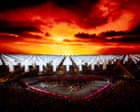
Las Vegas’s Sphere takes on the characteristics of whatever it’s advertising on its exterior. Depending on when you look, you might see Orbi, the Sphere mascot, winking at you, or an ad for one of their Wizard of Oz showings, or maybe a roiling mass of red flames and shocks of lightning announcing the arrival of Metallica for their residency Life Burns Faster. Looking at it feels like staring at the end times.
It’s like a huge black hole, sucking in the jittery sun-blasted energy of Vegas and transmuting it into an ominous ode to the renegade titans of thrash, but, you know, an older, wiser, therapized version of the band. This is the first night of Metallica’s 24-show residency, and it features the return of their “no repeat” format, meaning they play twice a week without repeating a single song during that week. It’s a showcase of the breadth of their catalogue as much as it’s a reminder of just how many indelible classics they’ve written.
It also makes for a more interesting show. It’s not especially difficult for Metallica to play hours of hits, but it’s more fun when they forgo a few obvious ones in favor of a larger narrative. The implication of the unpredictable set list means that these shows are for the real fans.
On night one, the band avoid a full nostalgia grab, playing Hardwired … to Self Destruct’s marching Now That We’re Dead from 2016, the furious Lux Æterna from 2023’s 72 Seasons, and the half-ballad-half-catharsis of The Day That Never Comes, from 2008’s Rick Rubin-produced return to thrash Death Magnetic. The loose, non-chronological album-hopping allows the band to track their progress through their relationship to those real fans, focusing on emotion over adherence to a rigid greatest hits timeline. Yeah, they do not play Enter Sandman on night one, but they do play Ride the Lightning’s instrumental The Call of Ktulu while a giant, slimy Cthulhu unfolds itself and plods through Vegas, mottled skin shimmering as it grabs a fighter jet and throws it at the audience.
As much as I love that moment for the way it brings Metallica’s gruesome visual world into a twisted hyperreality, I can’t help but wish I am seeing the band in a tiny, sweaty venue without any visuals at all. They still hold so much kinetic energy and power. Everyone in Metallica is now in their early 60s, but it doesn’t seem like it.
Lars Ulrich finds new pockets to expand his driving rhythm, James Hetfield can still move his voice from gravelly-metallic snarl to full and rounded ballad, Kirk Hammett’s guitar-work is intricate and unpredictable, swerving when you think he’ll just keep ascending – he’s undeniably one of the greatest living guitarists – and Robert Trujillo’s percussive work on the five-string bass adds depth to everything, gluing it all together. In other words, Metallica don’t need the bells and whistles, but they’ve also long been a band that loves to experiment with their live show, and sometimes their entire identity: like when they invited a therapist to help them navigate interpersonal turmoil and then filmed the whole experience and released it as the documentary-cum-concert film Some Kind of Monster in 2004, or the time they performed a show they called Pandemica to virtually no one on an empty winery during those uncertain early months of the pandemic, and then toured a concert film of the event at drive-in movie theaters across the country. Most Metallica songs are built on constant forward-movement and simmering rage, but as they’ve gotten older they’ve peeled back the facade and revealed the self-awareness that allows them to avoid the nostalgia trap of seeming like faded versions of their former selves.
Extract — continue reading at the source.


