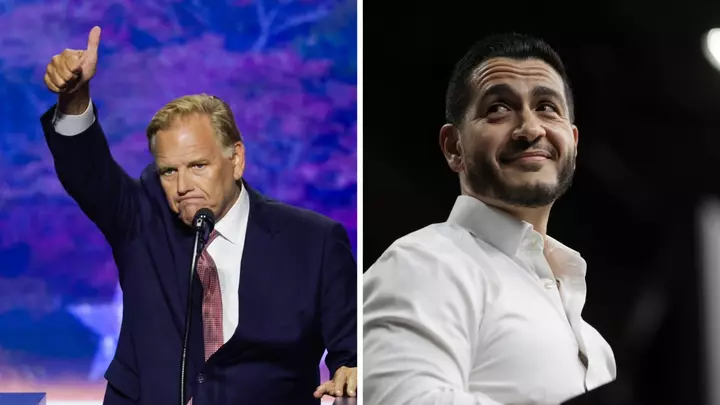
Michigan appears to be holding two different elections this November. In one, voters are being asked to decide what to do about Donald Trump's tariffs, the auto industry and an increasingly hostile relationship with Canada. In the other, the arguments revolve around Gaza, antisemitism and whether a Muslim candidate belongs in the United States Senate.
The two elections seem to have nothing to do with each other. One Michigan is preoccupied with the practical business of living in Michigan and the other has become a battleground for grievances imported from thousands of miles away, where questions of religion and identity increasingly compete with questions of public policy. The Senate race between Republican Mike Rogers and Democrat Abdul El-Sayed has made this division unusually difficult to ignore.
Rogers is trying to distance himself from Trump's tariffs while campaigning alongside a president who has questioned his opponent's loyalty to the country. El-Sayed, meanwhile, faces scrutiny over his positions on Israel and Gaza even as Michigan's manufacturing economy confronts questions that will outlast the election. Michiganders should be reminded that it is, indeed, possible to care deeply about Gaza and still want a serious discussion about the state's economy.
And yet, given the current state of affairs attached to the midterm, this seems impossible. Perhaps the clearest evidence that Michigan has become two political states is that Rogers appears to be running two campaigns. In one, he has called for an end to Trump's tariff war with Canada.
In the other, he appeared alongside the president at a rally where Trump called El-Sayed a jihadist and questioned his loyalty to America. The two messages belong to different political conversations, one concerning what Washington is doing to Michigan's economy and the other inviting voters to consider the religious identity of the man seeking to represent them. The first conversation has considerable public support.
A Detroit Regional Chamber poll found that 60.3 percent of Michigan voters think tariffs are hurting the automotive industry and a September 2026 New York Times/Siena survey found 67 percent opposed tariffs on Canadian goods. The second Michigan is considerably harder to measure, perhaps because its divisions are rooted in genuine disagreements over Israel and Gaza, compounded by concerns about antisemitism and anti-Muslim prejudice. Dearborn voted for Trump in 2024, after anger over the Biden administration's support for Israel fractured Democratic loyalties.
Extract — continue reading at the source.