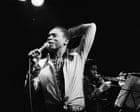
The singer and songwriter Mighty Sparrow, who has died aged 91, was quite simply the greatest calypsonian there has ever been. For at least five decades he was a monumental figure on the Caribbean music scene, while also capturing the hearts and minds of millions of fans around the world with self-penned songs that were the quintessential calypso mix of political commentary, humour, sexual innuendo and melody. Loved and feted by Trinidadians more than any other public figure in the island’s history, he was to calypso what Bob Marley was to reggae – an inspirational living legend.
In Britain, no less than elsewhere, the sheer wit and quality of classic songs such as Jean and Dinah, Congo Man and Mae Mae brought calypso to many who would never otherwise have encountered the music form, particularly in the 1950s, 60s and 70s, when he was in his prime. In 1956, aged 20, Sparrow made a breathtaking appearance in Trinidad’s annual calypso monarch competition, where he was mistakenly introduced on stage as Lord Melody, who was his idol. Showing the presence of mind, sense of fun and self-confidence that characterised his stage appearances, he jokingly began to sing a Melody tune before launching into his own new composition – Jean and Dinah.
A tongue-in-cheek celebration of the recent withdrawal of American military personnel from Trinidad – and the fact that local women would now have to turn their attentions to people such as Sparrow rather than their gum-chewing, nylon-toting guests – the song became an instant classic and gave its composer the title of Calypso Monarch, the ultimate achievement for a calypsonian. For good measure, its infectious melody also won Sparrow the 1956 Road March crown, awarded to the singer of the tune played most often on the streets at carnival each year. It was a hitherto unprecedented double and set him off on a period of dominance that would never seriously abate.
He went on to win both titles seven more times in all, a feat that was all the more notable because he essentially retired from the calypso monarch competition in the mid-70s. His only real rival throughout his career was his friend Lord Kitchener, who often beat him to the Road March title but failed to match his consistency. Although he was known throughout the world as a Trinidadian, Sparrow was born on the nearby island of Grenada, in Grand Roy, a fishing community.
When he was 18 months old his carpenter father, Rupert, who had moved to Trinidad seeking work, paid for his family to take the boat to join him in Port of Spain, where new oil wealth had tempted thousands of other “small islanders” to gather. Then known as Slinger Francisco, Sparrow spent his early life in the impoverished sectors of Port of Spain, which helped to shape the left-leaning political beliefs that later came out in songs such as Capitalism Gone Mad and Neurosis of the Rich. He often liked to call himself the “mouthpiece of the underprivileged”.
His mother, Clarissa, claimed her son’s musical bent derived from the fact that she was strutting her stuff at a dancehall at 4am when her labour pains began. His talent soon manifested itself at Port of Spain’s Newtown Catholic boys’ school, where he relished singing Gregorian chants and plainsong in Latin as head choir boy, as well as performing at the weekly Friday school concerts. At home he would reproduce some of the less risque local calypsos in front of his mother while playing on a comb and paper, and was influenced by the songs of Nat King Cole, Sarah Vaughan and Frank Sinatra on the radio.
Extract — continue reading at the source.