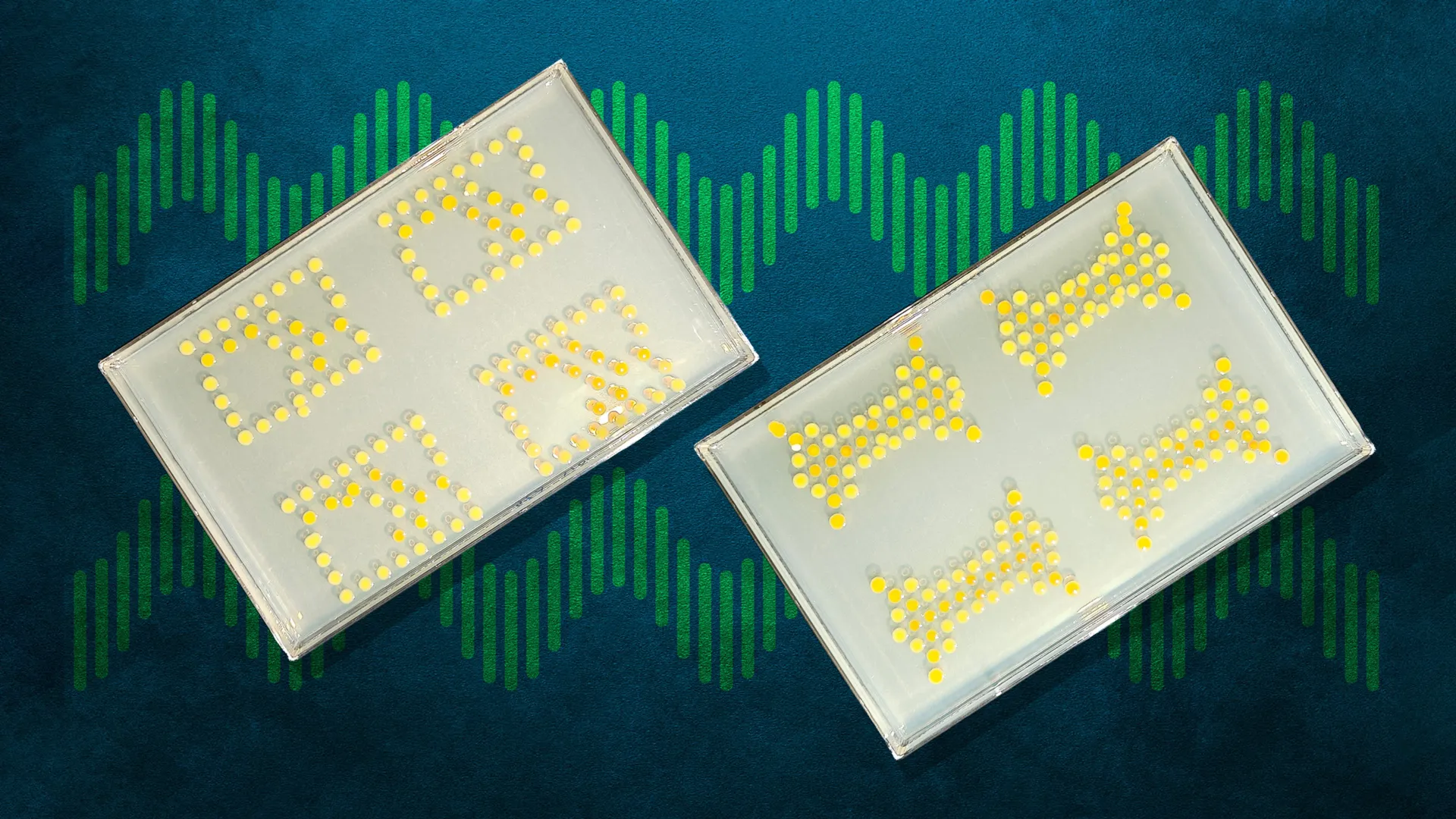
MIT researchers have engineered bacteria to work like transistors, creating living "circuit boards" that can be printed onto growth material inside a Petri dish. In conventional electronics, transistors act as switches that control whether electrical current can pass through a circuit. In the MIT system, engineered bacterial cells perform a similar role by regulating the movement of small signaling molecules.
Those molecules then carry information to other components in the biological circuit. The researchers created two types of bacterial transistors and three additional bacterial strains that act as relays between them. Together, these five strains provide a modular set of components that can be arranged to build nearly any kind of circuit.
In the new study, the team demonstrated circuits capable of adding two or three inputs and directing a single input toward a selected destination. "We've built some initial computer architecture components that are commonly used, but any operation can be built with these five strains," says Hamid Doosthosseini PhD '25, an MIT postdoc and the lead author of the new study. One potential use is to place these living circuits on plant leaves or roots.
There, the bacteria could process information about environmental conditions, helping plants detect and respond to stresses such as drought or pest attacks. Christopher Voigt, head of MIT's Department of Biological Engineering, is the senior author of the paper, which was recently published in Nature Chemical Biology. Former MIT postdoc Haorong Chen is also an author of the paper.
Turning Bacterial Cells Into Transistors Synthetic biology circuits are usually built by engineering cells to produce proteins and transcription factors that interact with one another. These systems can be programmed to carry out tasks such as detecting a particular molecule and then producing a specific response. Such circuits can perform different logic functions, but their complexity is limited.
Researchers generally need distinct transcription factors for separate operations so that signals do not interfere with one another. Because only a limited number of suitable transcription factors are available, there is a practical ceiling on how complicated a circuit can become inside a single cell. Packing too many circuits into one cell can also overwhelm its protein production machinery.
Extract — continue reading at the source.