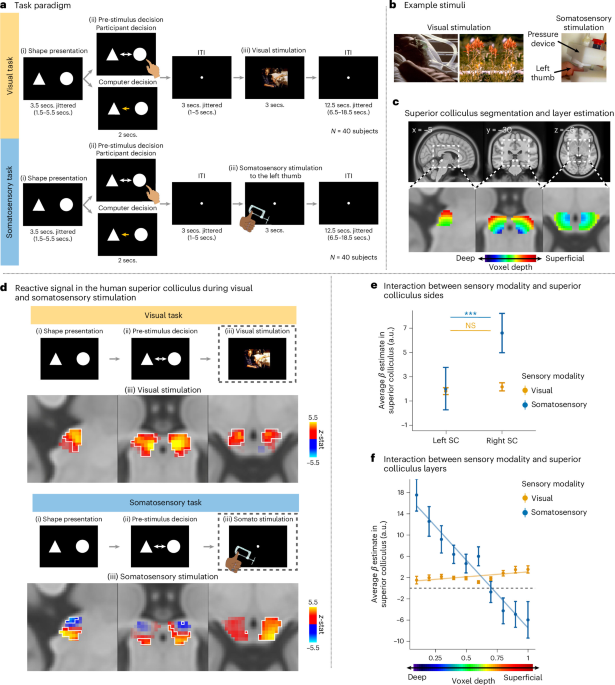
Inspired by recent theoretical work emphasizing predictive neural processing, we tested whether a midbrain structure for multimodal sensory integration—the superior colliculus—would show predictive responses to both visual and somatosensory stimulation. A multi-stage experimental design allowed us to test predictive activity in the human superior colliculus while 7-Tesla functional magnetic resonance imaging (fMRI) allowed us to map its sensory response across superior colliculus layers (N = 80). As expected from non-human animal work, visual and somatosensory stimulation elicited distinct depth-dependent responses.
We also observed a predictive response: these same modality-specific and depth-dependent effects occurred during task periods preceding direct stimulation, when sensorimotor input was identical between visual and somatosensory conditions. Further analyses rule out cross-trial carryover and show corresponding effects in the thalamic sensory nuclei. Here our results confirm that, in humans, the superior colliculus is sensitive to both visual and somatosensory input, and they demonstrate that it carries predictive signals for upcoming sensory events.
The superior colliculus, as the midbrain target of the optic nerve, has long been recognized as a crucial midbrain structure for visual attention and visually guided behaviors1. Non-human animal evidence also suggests that the superior colliculus plays an important role in non-visual (for example, auditory and somatosensory) processing. In non-human vertebrates, single-unit recordings demonstrate visual response among neurons in the superficial layer of the superior colliculus (organized into retinotopic receptive fields), yet neurons in intermediate and deep layers are sensitive to visual, auditory and somatosensory stimulation and to combinations of these inputs2,3,4,5.
Furthermore, neurons in intermediate and deep layers of the superior colliculus play a role in controlling motor movements of the eyes, head and body1,6,7. The consensus perspective from non-human vertebrate research is that the superior colliculus serves multiple functions in sensory processing, integration and control, which are organized at a fine scale across its anatomical layers. Although some evidence for similar functional organization exists in humans8,9,10,11,12, comprehensive validation remains limited, in large part because superior colliculus layers are difficult to spatially resolve using standard resolutions in 3-Tesla fMRI.
More importantly, however, this consensus perspective has largely focused on how the superior colliculus reacts to sensory stimuli, whereas emerging integrative perspectives on whole-brain function (that is, allostatic frameworks13,14,15,16,17 and predictive processing frameworks18,19,20) suggest that the brain predicts and prepares for sensory input that has not yet occurred. The present study both validates the consensus perspective in humans and extends it, using high-resolution 7-Tesla fMRI to show that the superior colliculus blood-oxygen-level-dependent (BOLD) response is organized across layers, sensitive to both visual and somatosensory stimulation, and occurs both in response to and in anticipation of visual and somatosensory stimulation. An allostatic perspective helps contextualize why sensory integration was previously observed in the superior colliculus21,22,23 (for review, see ref. 7) and makes further predictions about its functions.
Allostasis refers to predictive (as opposed to error-based) regulation, which allows the brain to leverage learned experience to avoid costly mistakes16,17. On this account, and in related predictive processing accounts13,18,19,20, the brain, as a whole, predicts sensory input using generalizations informed by past experience (that is, an internal model)—anticipating the sensory consequences (for example, visual and somatosensory) of a motor command13,20,24. If this is correct, then it follows that the superior colliculus, and other brain regions involved in motor control, should be sensitive to sensory predictions.
Extract — continue reading at the source.


