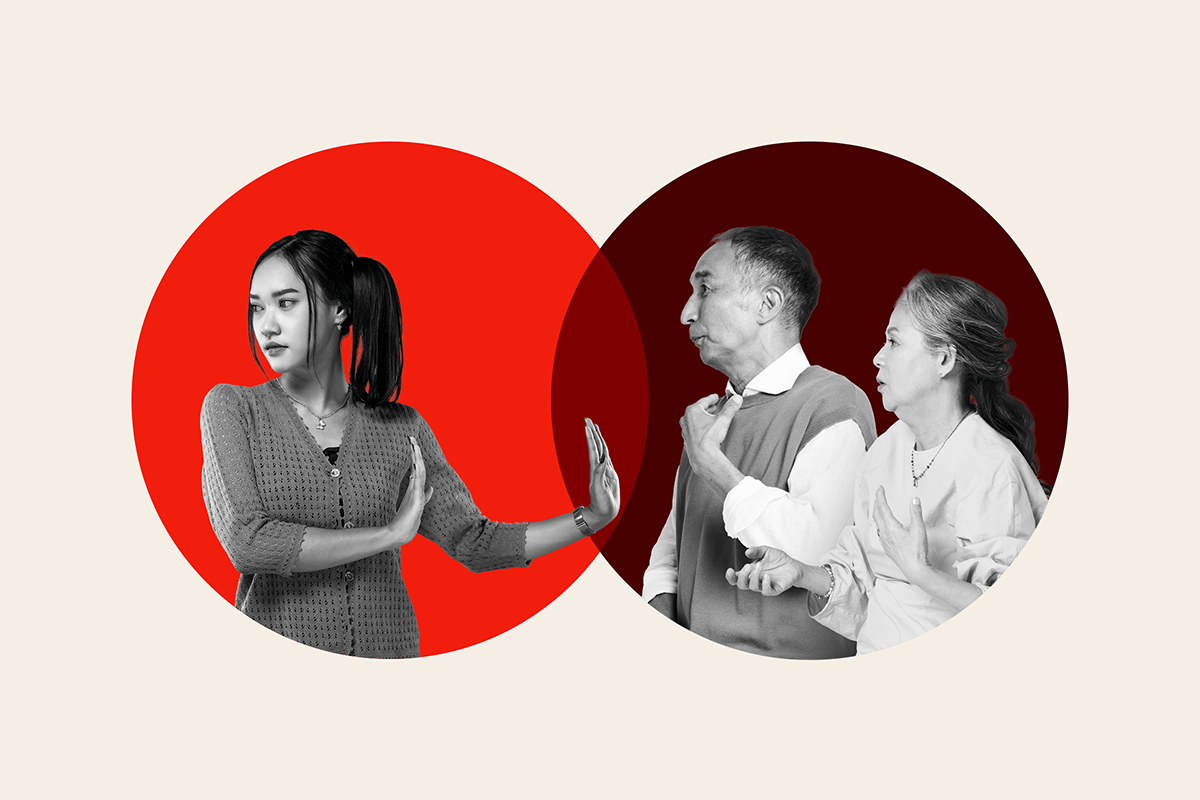
Whether it's a friend who no longer speaks to their parents, a relative who has cut ties with a sibling or another social media post about going "no contact," family estrangement is no longer a topic discussed behind closed doors. It’s reported that more than one in four American adults are estranged from at least one family member, according to research from Karl Pillemer's Cornell Family Estrangement and Reconciliation Project. In his 2020 book Fault Lines, Pillemer reported that 27 percent of U.S. adults, or roughly 67 million people, were estranged from a relative.
We’ve seen estrangement play out publicly among some of the world’s most famous families. Hilary Duff admitted on a podcast that she and her sister “don’t speak.” Prince Harry's highly publicized rift with the Royal Family has caused controversy for years. Most recently, Brooklyn Peltz Beckham revealed years of personal conflict with his parents, David and Victoria Beckham, in an Instagram statement.
While stepping away from harmful relationships can be necessary in some cases, some researchers and psychologists are becoming concerned that estrangement is increasingly being viewed as a first response to family conflict rather than a last resort. Blake, a psychology Ph.D. and author of the upcoming book Cut Off: Understanding Family Estrangement. Blake (@the_breath_geek on Instagram) believes the conversation around family estrangement has shifted dramatically in recent years, particularly on social media, where posts about "toxic" family members, trauma and going "no contact" have become increasingly common.
According to Blake, studies examining the consequences of estrangement have produced more nuanced findings than many people might expect. "What surprised me was that the assumption that parents are causing someone's mental illness doesn't seem to hold up particularly well when it's tested in people who actually go no contact," Blake said. While researchers disagree on how common estrangement is and definitions vary, Blake said multiple indicators point to a substantial rise in public interest over the past 20 years.
For example, Google Trends data show searches for terms such as "family estrangement" and "parental estrangement" have increased dramatically since 2004. Blake argues that part of the shift reflects broader cultural changes. Now, younger people view family relationships as something that must be continually earned.” Blake believes social media and what he describes as "therapy culture" have contributed to that change.
Discussions of boundaries, trauma and emotional safety can be valuable, he said, but may sometimes encourage people to interpret ordinary family conflict through a more clinical lens. Not everyone agrees with that assessment. Many therapists and mental health experts argue that estrangement can be a necessary response to abuse, neglect or ongoing harmful behavior.
Extract — continue reading at the source.