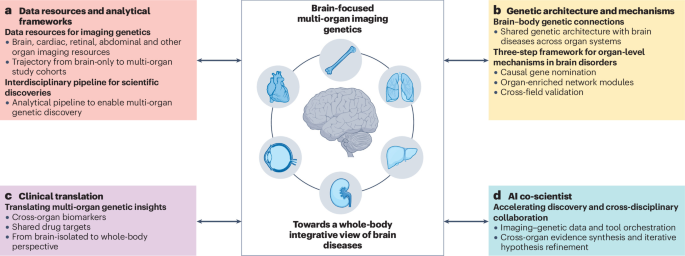
Population-based cohorts that combine genetic data with whole-body multimodal imaging are transforming how we map the genetic architecture of the brain in its broader bodily context. Historically, imaging genetics has focused largely on single organs, especially the brain, with separate efforts targeting the heart, skeleton and other organs for systemic diseases, and limited integration across organ systems. Yet, strong brain–body interactions and the high multimorbidity of brain and systemic diseases highlight the need for a brain-centred multi-organ perspective.
Here we introduce the emerging field of brain-focused multi-organ imaging genetics, outlining key data resources and interdisciplinary analytical frameworks for large-scale multi-organ genetic discovery and reviewing the genetic associations between brain diseases and imaging phenotypes across organ systems. We discuss how these advances support a whole-body integrated view of brain health and disease and how they are beginning to reshape clinical translation for neurological conditions. We outline a roadmap for agentic artificial intelligence co-scientists that work alongside human researchers throughout the scientific discovery process, arguing that such systems will be essential for achieving an integrated understanding of brain health and disease, both as tools for individual researchers and as a collaborative infrastructure for the whole field.
Large-scale cohorts combining genetic data with multi-organ imaging are enabling brain-focused genetic discovery across organ systems at scale and breadth. The genetic determinants of brain disorders are deeply intertwined with imaging phenotypes across the heart, retina and other organs, revealing a distributed whole-body genetic architecture underlying neurological and neuropsychiatric conditions. Multi-organ imaging genetics has uncovered shared genomic loci, colocalized causal variants and Mendelian randomization-supported genetic connections between body imaging phenotypes and major brain disorders such as Alzheimer disease, stroke and schizophrenia.
A three-step analytical approach, from causal gene nomination through organ-enriched network modules to cross-field validation, provides a principled framework for moving beyond statistical genetic association towards mechanistic understanding of brain disorders. Brain–body imaging genetics and broader multi-organ interaction findings are beginning to reshape clinical translation and clinical care beyond organ boundaries. Agentic AI co-scientists capable of empowering cross-disciplinary scientific discovery will be essential for realizing an integrated, whole-body understanding of brain health and disease.
This is a preview of subscription content, access via your institution Access Nature and 54 other Nature Portfolio journals Get Nature+, our best-value online-access subscription Receive 12 print issues and online access Prices may be subject to local taxes which are calculated during checkout Zhao, B. et al. Heart–brain connections: phenotypic and genetic insights from magnetic resonance images. Science 380, abn6598 (2023).
This study is one of the first large-scale efforts to systematically map the phenotypic and genetic correlations between cardiac and brain imaging traits, laying a foundation for the brain–body perspective. Article PubMed PubMed Central Google Scholar Scheitz, J. F., Villringer, A., Mikail, N., Gebhard, C. & Endres, M.
Extract — continue reading at the source.


