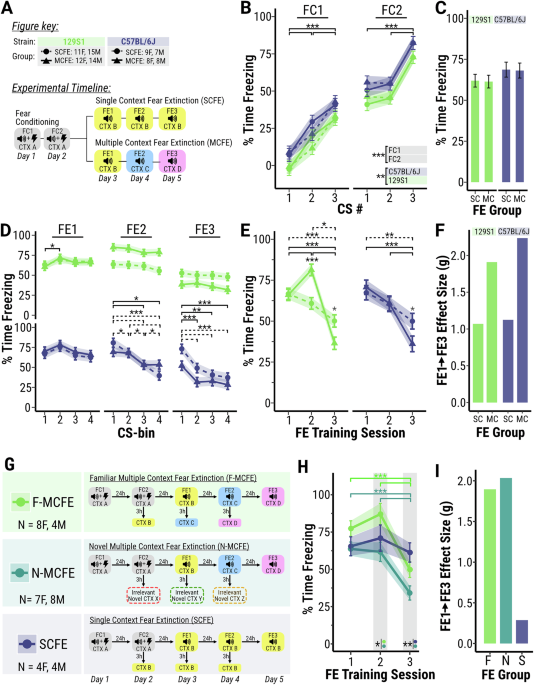
Extinction learning, which underlies exposure therapy, generates safety memories that are often context-dependent, limiting their persistence and generalization. Although varying contextual cues during extinction has been proposed to strengthen safety learning, the neural mechanisms remain unknown. Here, we compared fear extinction conducted in a single context (SCFE) or multiple contexts (MCFE) in 129S1 and C57BL/6J mice.
MCFE enhanced extinction learning and generalized extinction recall in novel contexts at 2-d, with this advantage persisting at 30-d when intervening testing occurred in the trained extinction context. This enhancement required exposure to distinct, but not novel, contexts and did not prevent spontaneous recovery or US-induced reinstatement. Dual Fos-TRAP activity mapping revealed differential recruitment of the fear conditioning-tagged cells following MCFE and identified the hippocampus as a key node supporting MCFE.
Consistent with this, chemogenetic silencing of dorsal, but not ventral, hippocampus selectively impaired extinction acquisition during MCFE and abolished its behavioral advantage. Likewise, local blockade of dopamine D2-, but not D1-like, receptors in the dorsal hippocampus eliminated the enhancement in extinction acquisition produced by MCFE. Together, these findings demonstrate that contextual variation strengthens and generalizes extinction learning through dorsal hippocampal dopamine D2-like receptor-dependent memory updating, identifying a neural mechanism through which behavioral modifications of exposure therapy can improve fear suppression.
Exposure therapy is the first-line behavioral treatment for PTSD and other fear-related disorders, yet fear relapse occurs in up to 50% of patients [1]. This high relapse rate is thought to reflect the failure of extinction-based safety memories to generalize across contexts and endure over time [2,3,4]. Exposure therapy is based on fear extinction (FE), the learning process in which repeated, safe encounters with feared cues reduce maladaptive fear and avoidance.
Experimentally, FE is accomplished by repeatedly presenting a conditioned stimulus (CS; e.g., tone) in the absence of the aversive unconditioned stimulus (US; e.g., footshock) that it previously signaled, resulting in progressive reduction of conditioned fear [5]. Importantly, extinction does not erase the original fear memory. Instead, it establishes a new safety memory that competes with the fear memory for behavioral expression [6].
Consequently, extinguished fear can return after the passage of time (spontaneous recovery), when the CS is encountered in a new context (fear renewal), or when the aversive US is re-experienced (fear reinstatement). Once a CS predicts both threat and safety, contextual cues become necessary for resolving this ambiguity by determining which memory is retrieved. The context-dependence of cued extinction is evident not only behaviorally but also in the neural representations of fear and safety memories.
Extract — continue reading at the source.